The risks for a director of closing a company and going into liquidation when a company is facing financial difficulty are many and varied. If a company is insolvent and unable to avoid insolvent liquidation, it should be closed. The risks of failing to close down the company will outweigh the risks of not doing so.
Directors should ideally take a step back and look at the situation to ensure they take the appropriate steps and advice they require as soon as possible. Many of the underlying risks for a director closing a company detailed in the guide below may not arise directly from closing the company, instead, the liquidation may crystalise pre-existing issues.
Suppose a company cannot reasonably avoid insolvent liquidation. In that case, even if the process is delayed because a director fails to take adequate steps to close down the company through the legal routes available under the Insolvency Act 1986 and the Companies Act 2006, the demise of the company is simply delayed. The risk to a director for trading on whilst insolvent puts them at added risk of making the situation worse. If the situation is made worse for creditors then the risk to a director personally rises under wrongful trading.
Risks For A Director Of Closing A Company Prematurely
Risks for a Director of closing a company go both ways. There are risks for not closing a company and going into liquidation. There are also risks for a director personally going into liquidation. This article will consider both angles.
For a director concerned about the risk of closing a company down and going into liquidation, the reality is the risk of not going into liquidation generally is greater than the risks associated with actually going into liquidation.
Few directors are likely to opt for insolvent liquidation as a choice made with haste or prematurely. It is perhaps the last thing they would wish to do. Most directors would much rather try to save the company rather than prematurely shut it down. For those reasons, there would be few (if any) cases in which a director has been successfully sued for prematurely putting a company into liquidation in breach of duty.
The risk of course, if a director prematurely shuts a company down, would be a loss of an opportunity that the company might survive and avoid insolvent liquidation with the benefits of future success that the company may have.
Putting a company therefore into liquidation prematurely is an unlikely event, rather like the prospect of a liquidator meeting a happy creditor. It generally is axiomatic that it does not happen.
Personal Liability Risk For A Director Closing A Company
The Insolvency Act 1986 sets out a formal legal procedure when companies are insolvent to enable directors to be proactive and if necessary go into Creditors’ Voluntary Liquidation. Many directors carry on trading beyond the point of no return, causing further loss to creditors and thereby can be at risk.
If a company is insolvent and unable to avoid insolvent liquidation, a director should consider taking steps to liquidate it as soon as possible. This is preferred to waiting for a creditor to take such steps. A director’s duties are to the company, which is a separate legal person from themselves. Tempting as it might be for a director to prioritise their interests ahead of the company’s, doing so puts them at risk because it is the company’s stakeholders and assets they are affecting not their own.
Under Section 172(3) of the Companies House 2006, a director should take into account the position of creditors when a company is insolvent:
The duty imposed by this section has effect subject to any enactment or rule of law requiring directors, in certain circumstances, to consider or act in the interests of creditors of the company.
Whilst it may be natural for a director concerned about their future and the ability to support themselves if their company were to go into liquidation, it is nevertheless the overriding duty to act in the best interests of the company due to Section 172 of the Companies Act 2006.
Inevitably the key issue is whether or not a director will be personally liable for any of the damage that might arise. Normally trading through a limited liability company relieves a director from the burden of personal liability. However, that position is often unavailable if director misconduct has arisen.
Breach Of Duty Risk For A Director Closing A Company
When a company is insolvent or at real risk of becoming insolvent, directors’ duties extend to what is known as The Creditor Duty. This duty says (as confirmed by the Supreme Court in the Sequana decision) that a director’s duty when a company is insolvent is to account for the interests of creditors.
If a director fails to do this and causes loss to the company and the position of creditors worsens, this may constitute a breach of duty, otherwise known as misfeasance. Misfeasance can mean a director can be ordered by a Court upon an application by a liquidator to make a contribution to the company’s assets in the form of compensation for the loss they are deemed to have caused.
Directors need to be aware of this risk they could face personally if they fail to take adequate account of the solvency of the company and the interests of creditors when a company appears to be on its last legs.
Risk To A Director From Wrongful Trading When Not Closing The Company
A company that is insolvent with no prospect of avoiding insolvent liquidation, then the risk to a director of not closing the company is that of wrongful trading, which arises under Section 214 of the Insolvency Act 1986. This is the risk of causing creditors added loss by trading on when a director should not do so.
The director has a potential defence to a claim for wrongful trading, notwithstanding the position of creditors may have worsened. However, that defence relies on the director having taken every step to avoid making the position of creditors worse. A failure to do so could place the director at risk of being ordered by the Court on the application of a liquidator for compensation for any extra losses by creditors overall for the period of wrongful trading.
Risk To A Director of Closing A Company Arising From Antecedent Transactions
A risk to a director when closing a company and it goes into liquidation can arise from what is legally known as antecedent transactions. This relates to what are known as transactions at an undervalue and preference payments.
What Is A Transaction At Undervalue?
A transaction at an undervalue arises when a company enters into a transaction for less money or money’s worth than what the company has provided. The period in which such transactions are potentially under investigation and review is two years ending with the commencement of the insolvent liquidation.
The consequence for a director who receives the benefit of a transaction at an undervalue under Section 238 of the Insolvency Act 1986 is they can be ordered by the Court on an application of the liquidator to repay the equivalent sum of money in compensation or return the relevant assets to the company that the director has received the benefit of.
However, that is not the only risk a director faces upon giving a transaction at undervalue to some third party, for example. In such an instance, whilst the director does not obtain the benefit of the transaction at undervalue but, by the duty of a director to act in the best interests of their company, such a transaction fails to meet that standard. This could be considered a breach of duty by the director and they could be held liable for the loss the company suffers due to such a breach of duty and misfeasance in light of Section 212 of the Insolvency Act 1986.
What Is A Preference Payment?
The risk to a director when closing a company arising from preference payments when it goes into liquidation depends upon whether they have received the benefit of one or whether they have provided the same to a party a connected or associate of the company or the director.
In such an event, by Section 239 of the Insolvency Act 1986, preference payments arise when a creditor of the company (it has to be a person who is a creditor) is placed into a better position than they otherwise would have been had the relevant transaction not been entered into in the first place. However, the law recognises that there are many instances when a company goes into insolvent liquidation that a creditor will be placed into a better position than they otherwise would have been had the relevant transaction not been done at a “relevant time”. The relevant time for preference payments is within two years of the commencement of insolvency.
Desire To Prefer
Of course, directors will pay creditors in the two years before the commencement of an insolvent liquidation. Still, these payments will not be classified as preference payments except if it can be demonstrated that the director was influenced by a desire to prefer and put that creditor into a better position. The case of Green v Ireland stated that the legal position was that the decision taken concerning putting a creditor into a better position was not when the payment necessarily was made but when the decision was taken to do so.
There is a statutory presumption that if a preference payment is given to an associate or connected party as to, the desire to prefer them. This is a rebuttable presumption and it is open to the recipient of the preference in such an event to demonstrate they have not been preferred and why they say they were not put into a better position.
Risks From A Bounce Back Loan When Closing A Company
If a company director has taken out a bounce back loan to help the business through the side effects of the Covid pandemic, then two risks commonly arise.
Application For The Bounce Back Loan
The first risk a director may face is the loan application if there is a bounce back loan investigation by the Insolvency Service after the company is liquidated. The maximum loan obtainable was £50,000. It was a requirement a director seeking such a loan would confirm, for the calendar year 2019 (or provide an estimated position if the company started trading after 1 January 2019) the turnover position.
The Bounce Back Loan Support Scheme did not permit a director to obtain a loan of more than 25% of the level of this turnover. A review of the Insolvency Service Director Disqualification outcomes set out why directors are disqualified. This commonly will show a persistent cause of disqualification is directors who exaggerated their turnover on the application for the bounce back loan.
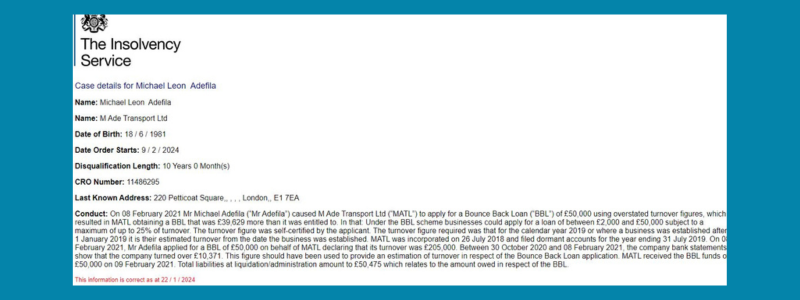
An example of such a listing extracted on 15 March 2024 related to the 10 year disqualification for Michael Leon Adefila which highlighted that:
On 08 February 2021 Mr Michael Adefila (“Mr Adefila”) caused M Ade Transport Ltd (“MATL”) to apply for a Bounce Back Loan (“BBL”) of £50,000 using overstated turnover figures, which resulted in MATL obtaining a BBL that was £39,629 more than it was entitled to.
Obtaining Multiple Bounce Back Loans
Less common, but undoubtedly a risk for a director, is there have been instances where directors applied for more than one bounce back loan for a company. This was not permissible. Only one bounce back loan was permitted per company.
The risk a director faces of either having exaggerated their turnover or applying for more than once bounce back loan is that they will be subject to investigation by the Insolvency Service and then face the prospect of disqualification proceedings.
In cases of exaggerated turnover and multiple applications for bounce back loans within the same company, a director risks being disqualified for up to 15 years from acting as a company director. A period of 9 to 11 years is not at all uncommon.
More serious cases of bounce back loan fraud arose when directors deployed dormant companies to apply for loans taken for personal purposes on an industrial scale. Not only is the prospect of disqualification proceedings commonplace in such cases but also criminal proceedings.
Misuse Of Bounce Back Loan Funds
However, aside from the rather common problem of inflating turnover on the applicable for the Bounce Back Loan, potentially the most consistent other issue facing a director is their incorrect use of the bounce back loan.
The bounce back loan support scheme provided directors with assistance and short term cashflow as a breathing space to alleviate the effects of the pandemic. A strict condition of the bounce back loan was that its use was for the economic benefit of the business, not for the economic benefit of the director personally. Many directors appear to have placed themselves at risk having used bounce back loans personally to repay their director’s loan account, which can constitute preferences if undertaken within two years of the onset of insolvency. Alternatively, some directors have transferred the bounce back loans from the business account to their personal bank account which they used for purposes unrelated to the business and its economic benefit. Such misuse of the scheme tends to be treated seriously by the Secretary of State and such directors can face the prospect of a heavy period of disqualification.
These risks do not increase because the company has gone into liquidation. Liquidation crystallises the pre-existing risk that was already there.
Overdrawn Directors’ Loan Accounts Risks For A Director Closing Down A Company
Likewise, with the issues arising from the misapplication or misuse of a bounce back loan, the risks a director faces closing down a company and going into liquidation can be crystallised if there is an overdrawn director’s loan account a director cannot repay.
As with bounce back loan risks (and indeed risks generally) the risk to the director personally in having to repay the overdrawn director’s loan account does not change when the company goes into liquidation and is closed down. That risk was always there independent of going into liquidation. Liquidation brings the matter to a head for the director who may have ignored the problem for some time. Liquidation may crystallise the issue so that it has to be dealt with. If the company does not close and go into liquidation, the overdrawn director’s loan account could worsen as trading continues. The director might continue to use the company’s funds to support their lifestyle.
If anything, it could be argued closing down the business is to the benefit of the director in preventing them from making such a position worse. All too often directors of small and medium sized companies seem somewhat unaware of the risk of drawing money from the company by directors’ loans instead of drawing a salary and dividends.
Risk To A Director Arising From Unlawful Dividends When Closing Down A Company
The risks for a director closing a company from unlawful dividends when going into liquidation is similar to the problem with the overdrawn director’s loan account.
Unlike the overdrawn director’s loan account, which may have the additional problem of Section 415 Income Tax (Trading and Other Income) Act 2005 if written off, an illegal dividend is repayable by the director personally who has received the same as the shareholder. It may amount to misfeasance when the company is insolvent and unable to declare and pay dividends to the shareholders.
The risk faced by the director is whether or not they have received the dividend themselves that they may be called upon to compensate the company for loss arising from its existence.
Beware Of Statistics On Disqualification And Criminal Proceedings
The risk to a director from closing a company by going into liquidation and then being disqualified as a director is statistically relatively low.
In a typical year out of roughly 75,000 directors likely to have a company go into liquidation, roughly 1,000 will be disqualified. The risk to a director of being faced with criminal proceedings on closing down a company that goes into liquidation is even lower. It is a matter of usually fewer than a couple of hundred directors each year who are handed a criminal conviction.
Whilst statistically speaking the risk of disqualification or criminal proceedings seems to be low, it is worth considering two points that highlight this is no trivial matter:
- The number of directors faced with disqualification or criminal proceedings is higher than those who are ultimately disqualified or receive a criminal conviction because proceedings can be discontinued or withdrawn by the Secretary of State.
- Whether a director faces disqualification or criminal proceedings is not determined by statistics; it is determined by the conduct of the director according to the facts of their case.
Beware therefore of statistics when assessing the risks as to whether or not you are likely to be faced at some point in the future (in the event of insolvent liquidation) with disqualification or criminal proceedings. Such matters will be determined for example by: Have I traded to the detriment of The Crown? Have I exaggerated my turnover in a bounce back loan? Did I deploy the bounce back loan monies for the economic benefit of the business or the economic benefit of myself? Have I continued to trade when I shouldn’t have done because the company inevitably was going into insolvent liquidation but I continued nevertheless to the detriment of creditors? Have I entered into transactions that may constitute transactions at an undervalue or preference payments which were not in the best interests of the company at the relevant time they were entered into? Finally, is there an aspect of my conduct at a significant level which would demonstrate and be clear to an impartial person that the transactions and conduct entered into were not in the best interests of the company and its future prosperity?
Those questions are not an exhaustive list a director could ask themself.
If you are concerned you should take independent professional advice to look into such matters to assess your risks. However, a notable feature of such a review of risks does not change the fact that if indeed a director breached their duty to a company when it was insolvent and caused some form of loss to its creditors, then only if a director has taken adequate and reasonable steps to compensate the company, such risks cannot realistically be mitigated by avoiding the liquidation.
Whether the company goes into liquidation readily or does not do so for some time, does not take those risks away. They are there regardless. Such risks therefore do not arise by closing down a company and going into liquidation.
If the company survives and recovers, then the risks may disappear. If the company becomes solvent again, it is open to the directors to seek to ratify the breaches of duty they have caused by reference to the company’s shareholders under Section 239 of the Companies Act 2006.
GET IN TOUCH FOR HELP
For a free no obligation chat about any of the matters detailed above, please do get in touch for help. An expert will call you back or if you prefer exchange emails.
We can explore your situation and consider the best way to help you and your business needs. You can call us 020 3925 3613 or fill in the form below and will get back to you quickly. We Know Insolvency Inside Out.