Bounce Back Loan Investigations Overview
Bounce Back Loan investigations are triggered typically when a Liquidator undertakes their Director Conduct Report to the Insolvency Service for the Secretary of State.
In every Creditors Voluntary Liquidation, the company is insolvent and the Liquidator will be required as part of their Liquidator Duties to consider and report to the Insolvency Service any potential abuse of the Bounce Back Loan Scheme that they discover during their investigation.
Creditors Voluntary Liquidations are by far the most common of the two types of insolvent Liquidations with the other being Compulsory Liquidation.

Turnover Conditions On A Back Bounce Back Loan Application
The Bounce Back Loan Scheme had certain strict criteria based on the financial circumstances of a company applying for a Bounce Back Loan (“BBL”).
Those conditions related to a company’s solvency, the level of turnover it was required to have relative to the size of the loan being applied for (needed to be four times the loan applied for), and the way in which the money obtained was then used for the economic benefit of the company.
Any breach of those conditions could be serious for a Director who had applied for a BBL, potentially leading to Director Disqualification Proceedings and in some cases criminal prosecution. In most cases, the Insolvency Practitioner will have referred the matter to the Insolvency Service. It might be the investigation of the Liquidator or the Insolvency Service or both that culminate in the outcome of the Bounce Back Loan investigations.
A Bounce Back Loan application form may have been set out as follows (which has been extracted from one of the major commercial banks that lent funds under the scheme) to address questions about a company’s turnover. This was used to set the maximum amount that could be applied for up to 50,000:
You can apply for a loan which is up to 25% of your turnover in calendar year 2019, from a minimum of £2,000 up to a maximum of £50,000. If your business was established after 1 January 2019, you should apply the 25% limit to your estimated annual turnover from the date you started your business.
The potential problem with this is what is meant by turnover in the calendar year 2019. Is it the turnover (sales figures) that apply to a set of annual accounts where the year end is during the calendar year 2019 or perhaps more likely, is it the turnover that arose during the 12 month period January to December 2019? If the latter, then as many businesses do not have a year end 31 December the calculation of turnover would often involve apportioning turnover during typically two accounting periods. Furthermore, when undertaking such calculations for seasonal businesses would it have been permissible to calculate turnover on the basis of a pro rata basis or would the application for the loan be required to go through their management accounts (if they had any) and extract the figures by month.
To ensure the application was correctly completed then in all likelihood the turnover stated should have been calculated on a month by month basis betweeen the period January to December 2019.
Estimated Turnover
Another issue that might have arisen was the “estimated turnover”.
If a business started trading after 1 January 2019 it was permissible to estimate annual turnover. The question there is what is a reasonable basis to estimate the turnover i.e. is it to take the actual trading figures for a few months say and then extrapolate that into a 12 month period. Alternatively, was a business entitled to estimate turnover on the basis of its order book?
These conceivable unknowns seem to have led to some ambiguity in how this part of the scheme was to operate.
It is perhaps likely that provided applicants of Bounce Back Loans could justify their assumptions then estimated turnover could be calculated in a number of different ways. However, when challenged to produce such assumptions a business applicant without evidence and reasonable arguments may find themselves in some difficulty.
Use Of Bounce Back Loan Monies
Use of Bounce Back Loan monies has been a key issue that has sparked Bounce Back Loan investigations.
Many SMEs are funded by the business owners who run the companies. As the pandemic began to bite many business owners needed to lend money to their companies to survive. In some instances, there have been cases when Bounce Back Loan monies were received that were then in effect quickly transferred to the business owners to be offset against their Director Loan Account.
However, if the company shortly thereafter went into Liquidation such arrangements could well have been considered a Preference and then clawed back by a Liquidator.
In other instances, it has not been unknown for business owners to in effect live off the Bounce Back monies when business income dried up during the Covid Pandemic, instead of using them for the economic benefit of the company. Whilst business owners could usually use the funds to pay their usual salary, for example, it would be much more difficult to justify using these funds exclusively for the same.
Evidence From Director Disqualification Cases
To determine the causes of Bounce Back Loan investigations we have examined data from cases where there has been a known investigation. Such investigations are known because they have produced a clear result, resulting in a period of Director disqualification when the misconduct complained about specifically related to Bounce Back Loan abuse.
We have taken data from Director disqualification proceedings resulting either in a disqualification order or undertaking over the period around the last three months by analysing complaints in the 212 cases published by the Insolvency Service.
The evidence shows multiple complaints have arisen in some cases. There also appears to be some overlap where the four key complaints are concerned.
In some cases all of the key complaints may have arisen ie. a BBL was improperly applied for, deployed for personal purposes instead of for the business and the Director(s) did not keep satisfactory records to enable matters to be investigated.
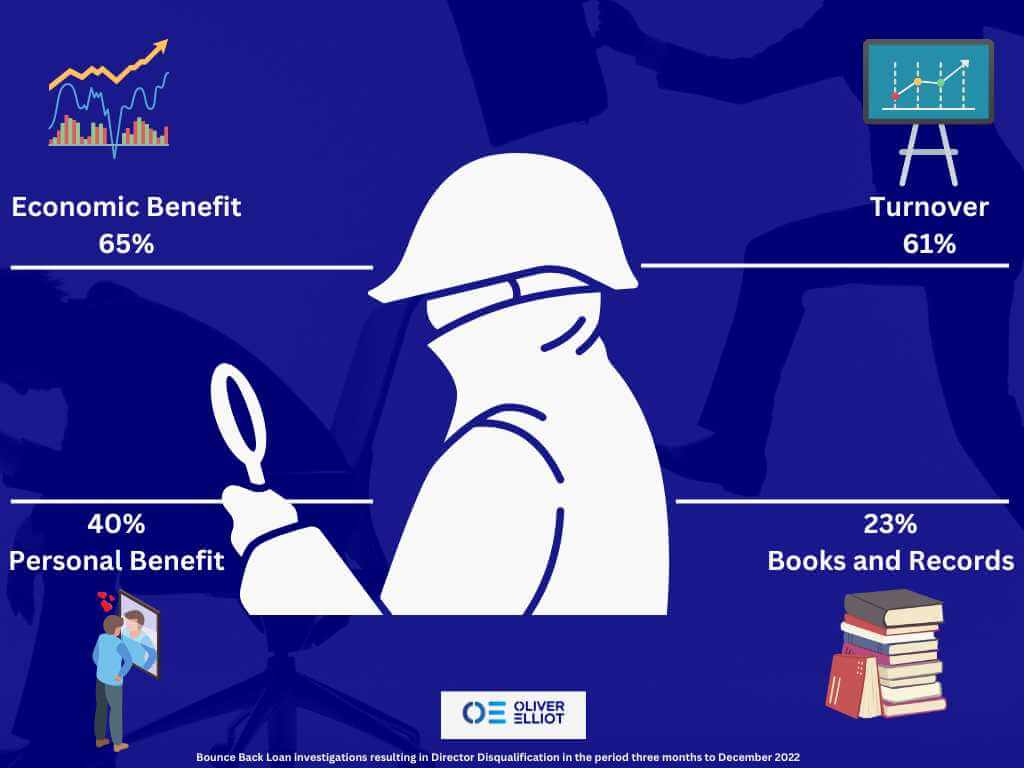
It seems the biggest issues arising in Bounce Back Loan investigations are an improper use of the funds and the application for the BBL being occasioned by exaggerated turnover.
Out of the 212 BBL cases resulting in Director disqualification around the three month period of September to November 2022, 138 (65%) highlighted a failure to make use of the loan on the terms offered, ie. for the economic benefit of the company.
The BBL investigations suggested in a majority of these disqualification cases, the loans should not have been applied for by the Director in the first place as there was no entitlement to it given the level of turnover of the relevant company. This issue arose in 129 of these recently reported cases (61%).
BBL funds being used for personal purposes showed up in 84 cases (40%) and in 49 cases (23%) it was noted that the company had inadequate records to assist the investigations.
Key Takeaway
Directors with BBLs may therefore now see from the analysis of this data the likely key triggers for an investigation if the Bounce Back Loan Scheme has been abused.

Have you taken out a Bounce Back Loan?
If you are a Director of an insolvent company with a Bounce Back Loan, Oliver Elliot can help you. We Know Insolvency Inside Out.

Share This Page!
What Next?
Expert Advice Is Just A Click Away
If you have any questions in relation to What Is Causing Bounce Back Loan Investigations? then contact us as soon as possible for advice. Oliver Elliot offers a fresh approach to insolvency and the liquidation of a company by offering specialist advice and services across a wide range of insolvency procedures.
Our expertise is at your fingertips.
Disclaimer: What Is Causing Bounce Back Loan Investigations?
This page is not legal advice and should not be relied upon as such. You can contact us on the specific facts of your case to obtain relevant advice via a Free Initial Consultation.
Whilst every reasonable effort is made to ensure the accuracy of the information herein this article is provided for information purposes only and should not be relied upon without a full review of the data used for this review from Director disqualification outcomes: summary of results.
Recent Posts / View All Posts