Overview Of Living Off Of Having An Overdrawn Director’s Loan Account
There is a risk of living off an Overdrawn Director’s Loan Account because it is a loan; it is not a dividend and it is not a salary.
If you are overdrawn at the bank you owe it money. If you are overdrawn at the company you owe it money in perhaps a similar way.
So why is living off an Overdrawn Director’s Loan Account such a potential risk? The answer is because the day might come when it has to be repaid and it might lead to some distortion of the accounts.
How Does A Director Living Off An Overdrawn Director’s Loan Account?
The way a Director can live off an Overdrawn Director’s Loan Account is by drawing money out of the company’s bank account, putting it into their personal bank account and using those funds to live off. The risk of transferring money from the company’s bank account to the Director’s personal bank account is it can be done without any thought as to what such payments represent.
As the weeks and months pass by the matter can develop and the Director’s Loan Account can become progressively more and more overdrawn. The problem can therefore get bigger and bigger.
The more time that passes by, the more difficult it is to treat because monies extracted months ago cannot be reclassified as salary or dividends. It is outside the scope of this post but for explanations on why this is the case feel free to consider the following posts which explains why you cannot recreate history:
As a result, the annual trip to see the Company’s financial adviser or agent to discuss the annual accounts may not necessarily enable the matter to be resolved, particularly if a company is not in a healthy financial position.
Annual Accounts Meeting
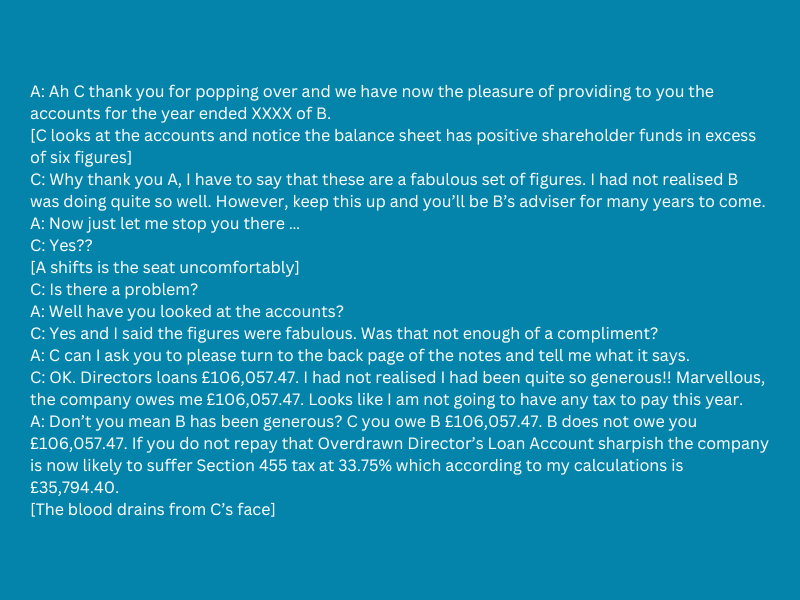
Picture the scene at the annual accounts meeting when the Director convenes the Annual General Meeting of the company to coincide with a trip to the company’s financial adviser to go through the accounts.

For the purpose of this hypothetical demonstration of a client meeting adviser, the adviser is called A, client Director is called C of a company B. C turns up at the offices of A to go over the accounts and the hypothetical transcript of a fictional meeting might go as follows (it has deliberately been somewhat exaggerated in a somewhat light-hearted way to make the point and add a little colour).
An Asset Of The Company
As the company has lent money to the Director, when they are overdrawn the Director’s loan account is an asset of the company.
Money a Director receives from a company that is over and above what they are owed by the company forms the Overdrawn Director’s Loan Account.
You generally cannot receive (as a Director) money from a company tax free except if you are owed it by the company. In most instances, the receipt of money will have tax consequences one way or another.
The Company Is Taxed On The Overdrawn Loan Account Of The Director
To prevent Directors from drawing loans from the company without there being tax consequences the company suffers tax on the Overdrawn Director’s Loan Account. If the company can pay this all well and good. When the loan is repaid the company can reclaim this tax under Section 458 of the Corporation Tax Act 2010.
The problem is a Director who is unaware the money they have had and used to live off is a loan from the company may yet be in for a bigger shock than C.
The Insolvency Problem And The Risk Of Living Off An Overdrawn Director’s Loan Account
If a company is successful then in the case of an owner managed business the Directors can typically (subject to compliance with statutory procedures) declare a dividend to clear the Director loan account. The shareholders will be taxed on those dividends.
However, if a company is insolvent dividends cannot be declared.
The risk of having an Overdrawn Director’s Loan Account is highlighted when a company is insolvent and then goes into Liquidation.
Two key problems sprout:
- The Director will likely be called upon by the Liquidator to repay their Director loan account.
- The point of insolvency will be examined which may expose a Director to the risk of claims for being in breach of the Creditor Duty.
Risk Of Having To Repay Overdrawn Director Loans
When the company is under the control of the Director, they can determine if, when and how the Overdrawn Director’s Loan Account is repaid. However, once the company goes into Liquidation the Director loses their powers, for example by virtue of Section 103 of the Insolvency Act 1986 in the case of a Creditors Voluntary Liquidation (the most common type of insolvent Liquidation) the Liquidator has a duty to realise the company’s assets, including Director’s loans due to the company.
Risk Of Allegations Of A Breach Of Duty
When a company is at real as opposed to remote risk of insolvency Director’s duties dictate that a Director has what is known as the Creditor Duty. The interests of creditors will intrude and outflank the duties owed to the shareholders.
The problem presented by the Overdrawn Director’s Loan Account is it can sit on the balance sheet of the company accounts even when a Director has no intention of repaying it. Although perhaps in such an event it should be written off so that the company accounts show a true and fair view, if this does not happen for any reason, it can risk distorting the perception of the financial position of the company.
For many small owner managed companies the Overdrawn Director’s Loan Account can be a substantial asset of the company. If a Director cannot afford to repay it then it can inflate the position of the balance sheet. This might lead a Director to envisage their company is in healthier shape than it really is.
A Director has a duty to ensure they are aware of such matters. If they do not do so and trade on whilst insolvent then transactions entered into might be capable of being challenged by a Liquidator and a Director might have to compensate the company for such losses they have caused that might be in breach of the Creditor Duty.
These risks commonly can arise when companies go into insolvent Liquidation. To attempt to avoid them in the first place one way would be for a Director to draw money from a company as salary. Whilst it is possible taxes paid might be higher than drawing dividends, these nevertheless would be spread over a period of time as opposed to the unwelcome surprise that the risk of an Overdrawn Director’s Loan Account can present on Liquidation.
Oliver Elliot Comment

It is not uncommon for a company unable to declare a dividend to clear the overdrawn Director loans (of insufficient reserves), to drift into a worsening position on the Overdrawn Director’s Loan Account. Although there are undoubted exceptions (such as it being done for tax reasons) the sight of an increasing Overdrawn Director’s Loan Account can be a sign a company is in financial difficulty.
For a free no obligation chat about any of the matters detailed above, please do get in touch for help. An expert will call you back or if you prefer exchange emails.
We can explore your situation and consider the best way to help you and your business needs. You can call us 020 3925 3613 or fill in the form below and will get back to you quickly. We Know Insolvency Inside Out.


What Next?
Expert Advice Is Just A Click Away
If you have any questions in relation to Risk Of Living Off An Overdrawn Director’s Loan Account then contact us as soon as possible for advice. Oliver Elliot offers a fresh approach to insolvency and the liquidation of a company by offering specialist advice and services across a wide range of insolvency procedures.
Our expertise is at your fingertips.
Disclaimer: Risk Of Living Off An Overdrawn Director’s Loan Account
This page is not legal advice and is not to be relied upon as such. This article Risk Of Living Off An Overdrawn Director’s Loan Account is provided for information purposes only. You should take independent advice on the facts of your case. No liability is accepted for reliance upon this post.
Recent Posts / View All Posts