Can HMRC stop a company being wound up? No, HMRC cannot stop a company from being wound up.
There is a common misconception about this which will be explained in this quick guide when HMRC objects to a company being struck off at Companies House. It is not stopping a company from being wound up; it is stopping a company from being dissolved without first going into liquidation.
If the directors of a company (typically an owner managed business) wish to stop trading and wind it up, they cannot be forced by HMRC to keep the company open even if it is insolvent.
What Is Meant By Winding Up A Company?
When a company is dissolved by being struck off at Companies House, it is not wound up. It is simply removed from the register of companies. This is fine for a company without any debts but not often suitable for a company with debts.
For a company with debts to be wound up, it will often need to go into liquidation before being dissolved. All of the company’s administrative and tax burdens will need to be regularised and brought into some reasonable order.
In order to go into liquidation a company with debts will need to appoint a liquidator who will bring about an orderly winding up, realise the assets, investigate any misconduct issues and distribute any surplus after discharging the costs of liquidation.
The Right To Wind Up A Company
The law expressly permits a company to be wound up whether it is insolvent or indeed solvent without debts if the shareholders wish for this action to take effect.
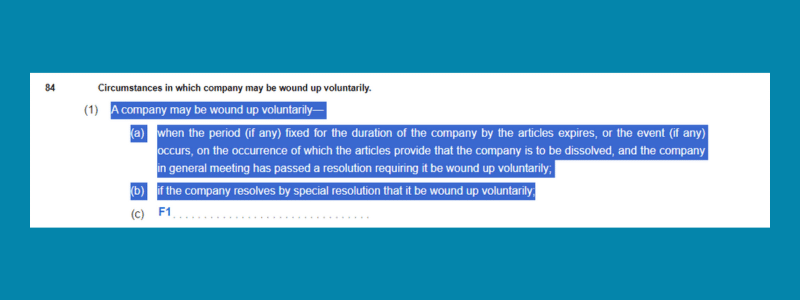
Under Section 84 of the Insolvency Act 1986, a company can be wound up:
A company may be wound up voluntarily—
-
when the period (if any) fixed for the duration of the company by the articles expires, or the event (if any) occurs, on the occurrence of which the articles provide that the company is to be dissolved, and the company in general meeting has passed a resolution requiring it be wound up voluntarily;
-
if the company resolves by special resolution that it be wound up voluntarily;
Difference Between Strike Off And Liquidation
The difference between a company being struck off and wound up is that when a company goes bust owing creditors money there is an investigation of the directors in a liquidation by the liquidator.
Once people are losing money there is a need for misconduct by directors not to run unchecked. This is a key purpose behind the winding up process which results in what is known as director conduct reporting in a liquidation.
When a company is struck off at Companies House there is no investigation into a director’s conduct. There is no liquidator or indeed anyone else appointed. There is no process of being wound up.
The government has acknowledged this can lead to abuse and as a result, the Insolvency Service can now start investigations of dissolved company directors. However, this is far from the norm.
Does HMRC Stop Companies Being Wound Up?
It is simply a complete fallacy to suggest that HMRC seeks to stop companies from being wound up.
What HMRC is doing is filing an objection to striking off a company by preventing companies that owe it money from being removed from the register at Companies House.
Although the most common liquidation procedure is what is known as Creditors Voluntary Liquidation (when a director initiates the winding up process) when it comes to winding up companies by issuing a winding up petition, HMRC is by some distance the most active creditor in winding up by placing them into Compulsory Liquidation.
Could HMRC Stop Companies Being Wound Up?
HMRC could not stop companies from being wound up by being placed into liquidation even if it was part of its policy.
It is to be stressed that it is not understood to be a part of HMRC’s policy to stop companies from being wound up.
It is however understood that HMRC does require proper process to be observed and when companies leave HMRC debts unpaid it usually requires a company to be wound up by going into liquidation.