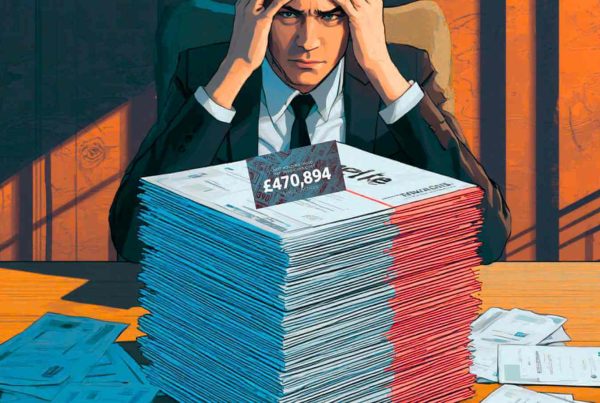
The case of Awan v Commissioners for His Majesty’s Revenue and Customs [2024] UKFTT 891 was one in which the taxpayer was fined by HMRC for failing to file a tax return required under Section 8 of the Taxes Management Act 1970.
However, the notable feature of this case was that the taxpayer did not have a liability for tax in respect of the return for which an HMRC tax penalty was issued.
The case was one in which the taxpayer was a sole trader and had historically filed tax returns under the self assessment regime.
Following income that fell below the personal allowance level the taxpayer had a couple of years in which HMRC withdrew the requirement to file a tax return.
Then for the tax year 2018/19 HMRC said she would need to file a tax return.
At some point, she signed up for electronic contact with HMRC. Her tax return for 2021/22 was filed 177 days after the due filing date being 31 January 2023. However, her income was below the personal allowance level so there was no tax to pay.
She thereafter received a £100 filing penalty for being late of £100 and further daily penalties culminating in a penalty assessment of £880 by virtue of paragraphs 3 and 4 of Schedule 55 of the Finance Act 2009.
What Is Reasonable Excuse?
Reasonable excuse for the failure to file a tax return was set out as follows:
Although there is not a definition of reasonable excuse in in the legislation, this Tribunal is required to approach the question of reasonable excuse in accordance with the decision of the Upper Tribunal in Christine Perrin v HMRC [2018] UKUT 156 (TCC) at [81]:
“81. When considering a “reasonable excuse” defence, therefore, in our view the FTT can usefully approach matters in the following way:
(1) First, establish what facts the taxpayer asserts give rise to a reasonable excuse (this may include the belief, acts or omissions of the taxpayer or any other person, the taxpayer’s own experience or relevant attributes, the situation of the taxpayer at any relevant time and any other relevant external facts).
(2) Second, decide which of those facts are proven.
(3) Third, decide whether, viewed objectively, those proven facts do indeed amount to an objectively reasonable excuse for the default and the time when that objectively reasonable excuse ceased. In doing so, it should take into account the experience and other relevant attributes of the taxpayer and the situation in which the taxpayer found himself at the relevant time or times. It might assist the FTT, in this context, to ask itself the question “was what the taxpayer did (or omitted to do or believed) objectively reasonable for this taxpayer in those circumstances?
(4) Fourth, having decided when any reasonable excuse ceased, decide whether the taxpayer remedied the failure without unreasonable delay after that time (unless, exceptionally, the failure was remedied before the reasonable excuse ceased). In doing so, the FTT should again decide the matter objectively, but taking into account the experience and other relevant attributes of the taxpayer and the situation in which the taxpayer found himself at the relevant time or times.”

No Special Circumstances
The Tax Tribunal did not find any special circumstances:
We therefore considered the submissions of the parties relating to reasonable excuse with care and find that the facts of this case, viewed objectively, do not amount to a reasonable excuse for the late filing of Mrs Awan’s tax return for tax year 2021/22. We acknowledge that Mrs Awan faced many competing demands on her time and also that there had been occasions in the past when HMRC had agreed that a filing would not be required. However, in this case, no call was made to HMRC ahead of the filing date to request the withdrawal of the notice to file, and it was only upon receipt by post of a daily penalty reminder that Mrs Awan became aware of the need to submit the tax return and about the accruing penalties. Mrs Awan had signed up to online communications and should have checked her online account. Notifications, both to file and of the initial and daily penalties, had been sent, and Mrs Awan had agreed to this method of communication in October 2021.
There is no suggestion that Mrs Awan has sought to avoid meeting any payment obligation or indeed that any tax for the 2021/22 tax year was due. This appeal is concerned solely with the obligation to file a tax return and the penalties for late filing imposed under sch 55 FA 2009. As noted by HMRC, the case of Barry Edwards v HMRC [2018] UKUT 131 (TCC) confirms that the sch 55 penalty regime is proportionate and that penalties fall due even where there is no additional tax liability.
With respect to special reductions, we therefore find that there are no special circumstances which indicate that HMRC’s decision not to make any special reduction of the penalties was flawed.
It follows that the Tribunal has decided that the appeal should be DISMISSED.
For a free no obligation chat about any of the matters detailed above, please do get in touch for help. An expert will call you back or if you prefer exchange emails.
We can explore your situation and consider the best way to help you and your business needs. You can call us 020 3925 3613 or fill in the form below and will get back to you quickly. We Know Insolvency Inside Out.


What Next?
Expert Advice Is Just A Click Away
If you have any questions in relation to File Tax Return Or Be Fined Even If There Is No Tax Liability then contact us as soon as possible for advice. Oliver Elliot offers a fresh approach to insolvency and the liquidation of a company by offering specialist advice and services across a wide range of insolvency procedures.
Our expertise is at your fingertips.
Disclaimer: File Tax Return Or Be Fined Even If There Is No Tax Liability
This page is not legal advice and is not to be relied upon as such. This article File Tax Return Or Be Fined Even If There Is No Tax Liability is provided for information purposes only. You should take independent advice on the facts of your case. No liability is accepted for reliance upon this post.
Recent Posts / View All Posts