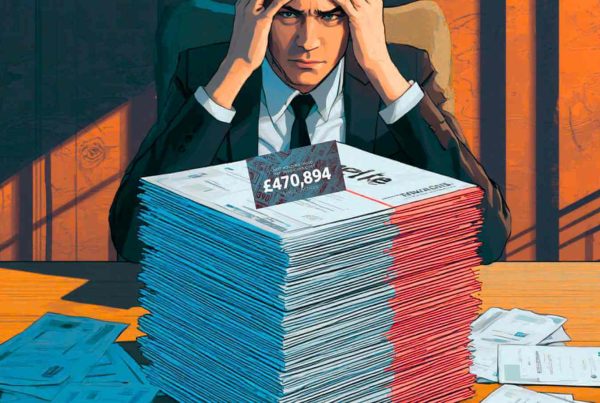
Can HMRC Debts Mean I Lose My House Overview
This post Will HMRC Debts Mean I Lose My House? arises because of the case of Revenue & Customs v Walsh [2023] EWHC 2213 (Ch) (“Walsh”). If you fail to deal with HMRC tax debts then you can lose your home.
The Walsh case shows the importance of keeping on top of your tax affairs with HMRC.
The latest stage of this litigation marathon related to an application by the taxpayer in November 2016 against Default Judgment obtained by HMRC on 10 March 2014 for £2,511,147.13 involving a catalogue of:
… four VAT assessments and penalty assessments, 20 income tax and CGT assessments made under section 29 Taxes Management Act 1979 (TMA), three determinations of penalties in relation to income tax and CGT and six penalty assessments for 2012 made under Schedule 55 and 56 of Finance Act 2009. The earliest assessments relate to the tax year ending in 1993.
to vary or set aside default judgment.

Charging Orders On Default Judgment
Charging orders were obtained by HMRC in April 2014 over various properties and made final in July that year. The taxpayer John Walsh had an HMRC tax investigation opened on 22 June 2010. The matter appears to have moved at a very pedestrian pace to still be ongoing in 2023 when orders for sale were made in respect of various properties of Mr Walsh following this latest decision.
The burden is on the taxpayer to calculate and disclose relevant information that explains the tax liabilities to HMRC. The regime that dominates the calculation of tax is known as self assessment. If the taxpayer fails to adequately attend to their tax affairs in submitting returns and thereby accounting to HMRC, it will calculate tax assessments based on the information it has available to it.
Appeal To Tax Tribunal
Previously the taxpayer had applied for permission to the Tax Tribunal to appeal the assessment and determinations. Those proceedings were Walsh v Revenue & Customs [2018] UKFTT 519 (TC) which highlighted the basis for and rationale of an HMRC tax assessment:
In Van Boeckel v Customs and Excise Commissioners [1981] STC 290 Woolf J identified the obligations placed on HMRC in order to come to a view as to the amount of tax to the best of their judgment. Assuming that there is some material before HMRC on which they can base their value judgment, they must perform that function bona fide but they “should not be required to do the work of the taxpayer in order to form a conclusion as to the amount of tax which, to their best judgment, is due”. In Rahman (trading as Khayam Restaurant) v Customs and Excise Commissioners [1998] STC 826 Carnwath J commented on Woolf J’s guidance and added that in order for a tribunal to treat an assessment as invalid, it needs to find, for example, that the assessment has been reached “dishonestly or vindictively or capriciously” or that it is a “spurious estimate or guess in which all elements of judgment are missing”, being in substance “tests [that] are indistinguishable from the familiar Wednesbury principles.
Mr Walsh produced a series of grounds to support his application. The problem with some of the arguments put forward was perhaps the apparently limited information that HMRC had. It is going to be a difficult argument for a taxpayer to challenge HMRC tax assessments because he or she did not supply complete information that HMRC might require to produce more accurate assessments and then complain about them later.
Here are some of the arguments.
Unjust Enrichment
The Tribunal said that Mr Walsh’s case appeared to be that the HMRC liability would be lower if he had provided full information to HMRC at an earlier time.
However, HMRC produces assessments based on information supplied by the taxpayer.
The Tribunal said:
However HMRC’s obligation under the assessment provisions where information has not been provided is to exercise its judgment on the basis of the information available, without being Wednesbury unreasonable: Van Boeckel and Rahman as referred to in the FTT Judgment….The submission that they are wild estimates or made other than by HMRC acting entirely in accordance with the scheme and applying appropriate judgment in circumstances where the underlying evidence was incomplete because of Mr Walsh’s own failure has no convincing basis on the evidence.
Right To Peaceful Enjoyment Of Property
Mr Walsh submitted that there was over-estimation of his HMRC tax debts which in turn would lead to his inability to enjoy his possessions due to paying more tax than required by legislation. He said the law should result in a reasonable estimate.
However, the Tribunal had previously found the HMRC estimates had been properly carried out. Estimates could only be prepared on information available and that process was to ensure that tax could be secured for the benefit of the population as a whole.
Delay
The argument on delay was dismissed inter alia because Mr Walsh had sought a stay:
Mr Walsh sought the stay of the Application while he pursued the remedy given to him by statute of making an appeal to the FTT and thereafter consensually agreed to postponements of the final determination of the Application.
Mr Walsh’s position is that he has been deprived by delay of the right to a fair trial under Article 6 or at common law. I do not understand that the argument can be advanced as amounting to a defence with a real prospect of success, rather than as a good reason under section 13(3)(b) which would have the effect of allowing Mr Walsh to defend the Underlying Claim. I consider illogical an argument that subsequent delay can be prayed in aid of the remedy of setting aside the Default Judgment, absent some realistic defence to the Underlying Claim, so that Mr Walsh may defend the Underlying Claim at a trial that will necessarily take place at some further time in the future.
Abuse Of Process
Mr Walsh suggested if HMRC were to recover more tax than they should have but the Tribunal said:
The statutory provisions have resulted in the amount of the Outstanding Liability. In the absence of a defence with a real prospect of success Mr Walsh’s contention that not setting aside the Default Judgment would result in over-recovery so as to bring the administration of justice into disrepute cannot succeed.
As to Mr Walsh not receiving communications, Mr Walsh was entirely the author of his own misfortune in that regard. He deliberately did not give an address for correspondence at the March 2013 meeting and positively asserted that he had no address. The power to make contact with HMRC was in his hands in circumstances where he knew that he had issues to address.
Promptness
The arguments about promptness were disposed of as follows:
The question then is did Mr Walsh act sufficiently promptly by waiting 3 months to make the Application? It was sufficiently clear to him that matters were serious that he had instructed legal and accountancy advisers by no later than 22 September, which is the date at which Mr Gilbert had instructed Mr Sobell and Mr Sobell was provided with the HMRC papers. To the extent that Mr Sobell was preparing a report as to Mr Walsh’s claimed true indebtedness, the material he needed was in the knowledge of Mr Walsh and not in the HMRC papers. The HMRC papers would only have provided information about the estimation process. On 30 September 2016 Mr Walsh signed a witness statement in which he said he had been advised that that his liabilities had been vastly overstated. Even if Mr Walsh could not have acted before 30 September, he could and should have made the Application on that date, by which he knew enough to take the formal step of applying to set aside the Default Judgment. There is no explanation for the further six weeks of delay.
Relief From Sanction
On seeking relief from sanction the Tribunal in Walsh said:
In all the circumstances of the case and the time that passed between entry of the Default Judgment and the making of the Application, the time that has passed since then and the lack of any meritorious defence would make the granting of relief unfair to HMRC.
Conclusion
As a result, the application was dismissed as the Tribunal said:
- No reasonable prospect of defending the claim on the grounds advanced.
- No good reason to set aside or vary the Default Judgment or defend the claim.
- Mr Walsh failed to act promptly.
Oliver Elliot Comment

A taxpayer is likely to face an uphill struggle complaining that an HMRC tax assessment is overstated if they have not provided sufficient information to HMRC. This is particularly so if they are seeking to rely upon their own default as the basis of HMRC’s estimate.
This particular rationale appears not all that dissimilar to the position set out in the insolvency case of Toone & Anor v Robbins & Anor [2018] EWHC 569 (Ch) which was considered by Mr Justice Norris when a company Director might be looking to defend and justify payments they have received from a company:
Directors who receive money from the company cannot be heard to say: –
“We have received company money: but our record keeping is so bad that the basis upon which we received it is unclear. So by reason of our defaults we ask you to assume in our favour that we took the money lawfully”.
For a free no obligation chat about any of the matters detailed above, please do get in touch for help. An expert will call you back or if you prefer exchange emails.
We can explore your situation and consider the best way to help you and your business needs. You can call us 020 3925 3613 or fill in the form below and will get back to you quickly. We Know Insolvency Inside Out.


What Next?
Expert Advice Is Just A Click Away
If you have any questions in relation to Can HMRC Debts Mean I Lose My House? then contact us as soon as possible for advice. Oliver Elliot offers a fresh approach to insolvency and the liquidation of a company by offering specialist advice and services across a wide range of insolvency procedures.
Our expertise is at your fingertips.
Disclaimer: Can HMRC Debts Mean I Lose My House?
This page is not legal advice and is not to be relied upon as such. This article Can HMRC Debts Mean I Lose My House? is provided for information purposes only. You should take independent advice on the facts of your case. No liability is accepted for reliance upon this post.
Recent Posts / View All Posts