
Overview Of Trustees’ Decision Not Perverse Says Court Of Appeal
Trustees’ decision not perverse says Court of Appeal in the matter of Patley Wood Farm LLP & Ors v Kicks & Anor [2023] EWCA Civ 901 (“the Patley Wood Appeal”). This was an appeal from Patley Wood Farm LLP v Kicks [2022] EWHC 2973 (Ch) (“Patley Wood 1”).
It is a decision likely to be welcomed by Insolvency Practitioners.
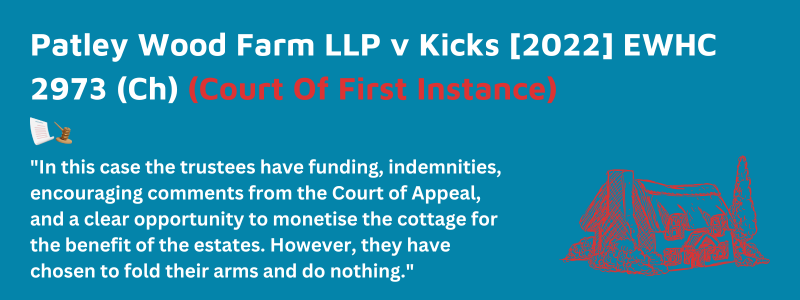
Patley Wood 1 was followed swiftly with a further judgment that deprived the Trustees in Bankruptcy from claiming certain of their costs (and those they were ordered to pay) from the Bankruptcy Estates. This was set out in the article Insolvency Practitioners Not Allowed Costs From Estate (“Patley Wood 2”).
Patley Wood Appeal To The Court Of Appeal
The Patley Wood Appeal was largely about when will the court control a Liquidator or Trustee in Bankruptcy. This is the so-called perversity test ie. conduct that no reasonable Insolvency Practitioner would undertake.

This matter concerns two Bankruptcy cases and it is reasonably safe to say, this is no litigation backwater. The basic background can be consumed by a review of the aforesaid articles on Patley Wood 1 and Patley Wood 2.
Patley Wood 1 Impact
Patley Wood 1 sent out tremors that might have been felt up and down the country by Insolvency Practitioners, particularly for those who may prefer to bypass involvement in litigation. No longer could it necessarily be relied upon that a Trustee in Bankruptcy could avoid becoming embroiled in costly litigation if they wished to do so by adopting a neutral stance. Patley Wood 1 suggested in some instances a creditor could potentially apply to Court seeking a direction for a Trustee to become joined in proceedings, particularly when creditors were prepared to fund and indemnify the Insolvency Practitioner.
The two Trustees in Bankruptcy appealed in the Patley Wood Appeal against a Court’s direction for them to be joined into proceedings meandering through the Court of Appeal. Those proceedings were referred to as the Eviction Claim.
The Bankrupts (the Brakes) were evicted from a property known as the “Cottage”. The eviction was then contested by them and their application was rejected by the Court of first instance. They then appealed to the Court of Appeal. Creditors in the Bankruptcies wanted the Trustees to oppose the Bankrupts’ appeal to be let back into the property.
Four Flaws Said The Court Of Appeal
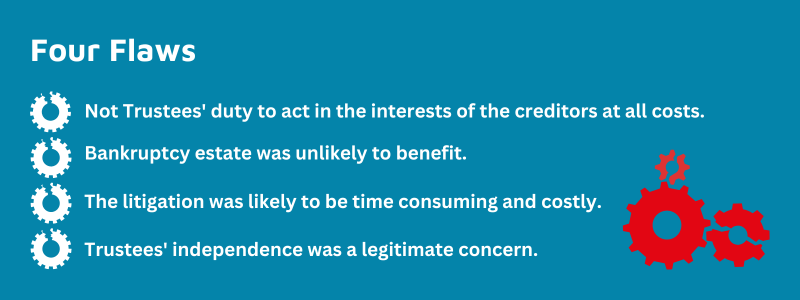
Lord Justice Arnold set out his four flaws as to the rationale of the Court of first instance:
It is common ground that the judge’s decision was an evaluative one. It follows that, given that it is not suggested that the judge made any error of law, this Court can only intervene if there is some identifiable flaw in the judge’s reasoning, such as a gap in the logic, a lack of consistency or a failure to take account of some material factor, that undermines the cogency of the conclusion: see Re Sprintroom Ltd [2019] EWCA Civ 932, [2019] BCC 1031 at [72]-[78] (McCombe, Leggatt and Rose LJJ, as they then were).
In my judgment there are four identifiable flaws in the judge’s reasoning. First, while the judge was correct to say that it is the Trustees’ duty to act in the interests of the creditors, what the judge failed to recognise is that the Trustees are experienced professionals who have a statutory discretion as to what steps they should take. It is not the Trustees’ duty to act in the interests of the creditors at all costs.
Secondly, the judge disregarded the key reason given by the Trustees, both in their initial letter dated 28 October 2022 and in Ms Kicks’ witness statement, for their decision not to apply to join the Eviction Claim appeal, namely that it was unlikely that this would result in any benefit to the bankruptcy estates, and hence to the creditors. On current figures, the bankruptcy estates are in deficit to the tune of well over £3.5 million. The only potential financial benefit to the bankruptcy estates of joinder is the £3,000 monthly licence fee offered by Chedington if the Trustees were to obtain possession of the Cottage. Even if this were to continue for a year until the Bankruptcy Application is resolved, the total sum payable would be £36,000. That would be a drop in the ocean.
The judge appears to have disregarded this factor when assessing the merits of the application because of what he said at [28] when considering the issue of standing. The judge was correct to observe that the fees charged by Mr Swift and the Trustees can be challenged by the creditors, and therefore there is no certainty that the full sums claimed will be allowed. Equally, however, there is no certainty that the sums claimed will be substantially disallowed. In the case of Mr Swift, his conduct is being challenged by the Brakes, which could lead to such a result; but it is supported by Chedington and, inferentially, by PWF and Mrs Brehme. Even if Mr Swift’s fees are substantially disallowed, it seems improbable that the Trustees’ fees will be. Furthermore, even if all the fees are disallowed, the estates will still be substantially in deficit and the licence fee offered by Chedington will not result in any dividend for creditors.
In some cases it might, I suppose, be argued that it would be of some benefit to the bankruptcy estate to reduce the size of the deficit even if that did not result in any payment to creditors. In the present case, however, it seems clear that the only possible benefit would be to increase the sums available for payment of the Trustees’ own fees. The Trustees are at least entitled to take the view that this is not a course of action that they wish to pursue.
Thirdly, the judge considered that it was difficult to see the downside to the Trustees in making an application for joinder. With all due respect to the judge, the downsides were obvious and have been confirmed by subsequent events. The Trustees have been forced to become embroiled in protracted, complex, time-consuming and hostile litigation. It was entirely predictable that the Trustees’ application would be opposed tooth-and-nail by the Brakes. We have not heard any argument on the grounds of opposition raised by the Brakes, and it would be inappropriate to express any view as to their merits, but the time estimate of two days given by counsel for the Brakes gives some measure of the potential scope and complexity of the issues. Furthermore, the Trustees’ concern about their exposure to costs has been amply vindicated by what has happened subsequently. It is not a satisfactory answer to this to say that it is commonplace for costs to be the subject of dispute in litigation or that the court can decide what is reasonable.
Fourthly, the judge dismissed the Trustees’ concerns as to their independence as “absurd”. I acknowledge that the present case cannot be equated with cases such as Re Ng [1997] BCC 507 and Trustee in Bankruptcy of Bukhari v Bukhari [1999] BPIR 157 which were relied on by counsel for the Trustees. Even so, it seems to me that the Trustees were entitled to be concerned about their independence being compromised. This is not a straightforward case of third party funding. The reality of the situation, as events since the judge’s decision have confirmed, is that Chedington, which is not a creditor, has not merely been funding the Trustees’ application, but also dictating to the Trustees what submissions they can and cannot make to the court regardless of the legal advice the Trustees have received.
Conclusion Of The Court Of Appeal
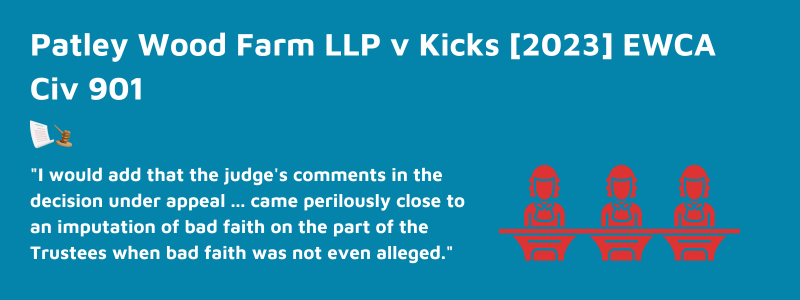
The Court of Appeal rejected the notion that the Trustee’s actions had been perverse.
Oliver Elliot Comment

An issue, in this case, is does an Insolvency Practitioner have to litigate.
Litigation is an endeavour rooted in commercial considerations. Typically if you lose in litigation you pay the other side’s costs and vice versa if you win. Not only that, litigation is all too often time consuming and the limited assets in many insolvency cases will naturally involve concerns over payment of officeholder remuneration.
Generally, the Court will not rush to involve itself in the commercial considerations of an officeholder except when the perversity threshold is reached.
It is relatively rare in insolvency matters for an officeholder to be required to enter into litigation that involves opposing the other side if there are no funds readily available to finance the same. The difference, in this case, was that creditors were offering to fund and indemnify the Trustees.
Patley Wood 1 directed the Trustees not only to join contested litigation but also that they adopt a particular stance i.e. in opposing an order for the Brakes to have possession of the Cottage. This in effect meant a seemingly unwilling litigant was being directed by the Court as to how they should conduct litigation.
In other words, had the decision of the Court of first instance stood then the Trustees might have lost their ability to decide for themselves how to plead the case as they saw fit. It seems the Court of Appeal recognised this potential threat to the Trustees’ independence. The fact there was funding to cover the Trustees’ risks was not seemingly the only relevant consideration.

Author: Elliot Green
Last Updated: October 18, 2026
Share This Page!
What Next?
Expert Advice Is Just A Click Away
If you have any questions in relation to Trustees’ Decision Not Perverse Says Court Of Appeal then contact us as soon as possible for advice. Oliver Elliot offers a fresh approach to insolvency and the liquidation of a company by offering specialist advice and services across a wide range of insolvency procedures.
Our expertise is at your fingertips.
Disclaimer: Trustees’ Decision Not Perverse Says Court Of Appeal
This page is not legal advice and is not to be relied upon as such. This article Trustees’ Decision Not Perverse Says Court Of Appeal is provided for information purposes only. You should take independent advice on the facts of your case. No liability is accepted for reliance upon this post.
Recent Posts / View All Posts