
Summary Of Pre Liquidation Pre Pack
The Pre Pack Administration is well known and has excited much interest and debate over the years, particularly since the commencement of the Enterprise Act 2002 but what about a Pre Liquidation Pre Pack?
At the heart of the question posed in the rubric is whether it is in fact the case that a Director transfers the assets to a new company and pays full market value for the company’s business when it is insolvent and Liquidation looks unavoidable, is at real material as opposed to remote risk personally in some way.
Theoretically, it could be argued that if a Director hoovers up the company’s assets pre Liquidation by transferring them to a new entity they control, it permanently distorts the market. They fetter the Liquidator from exposing the business to the market in seeking to achieve a going concern sale. Whilst that may be so, it appears a Liquidator looking to impugn such a transfer will have little option but to do so through obtaining an expert valuation of the business without being able to restore the business back to the original company as that avenue is lost.
In looking into this question we have considered a raft of technical irregularities pointing towards such conduct being unlawful. However, it appears there might be limited options available to enable a Liquidator to step in to restore the position.
A Director must not take such actions which may put the company’s solvency in peril and cause loss to creditors. It would appear, however, by paying full market value for the assets a Director may have poured cold water over some of their breaches. The rationale for this proposition is that many claims capable of being brought by a Liquidator would require evidence the company suffered a loss (see E D Games Limited [2009] EWHC 223 (Ch)).
What Is A Pre Liquidation Pre Pack?
There is no such recognised term per se as a Pre Liquidation Pre Pack, as with the concept of a Pre Pack Administration. A Pre Packaged Administration is a recognised well organised process overseen and ultimately actioned by an Administrator.
A Pre Pack Administration is the arrangement of the sale of a company’s business before commencement of Administration so that at the start of the process the appointed Insolvency Practitioner (Administrator) can sell the business to maximise realisations thereby minimise loss to creditors. Concerns festered for years (not unreasonably perhaps) that the process enabled in certain instances for company Directors to drop the creditors like a stone and in effect carry on trading the business in a new company.
The process was tightened up to assuage such concerns with tighter regulations imposed from 30 April 2021 via a revised version of Statement of Insolvency Practice Number 16 Pre Packaged Sales In Administration.
However what about the Pre Liquidation Pre Pack? It is an expression without real recognition; it is not organised by the Insolvency Practitioner. So what is it?
In effect, the concept of a Pre Liquidation Pre Pack can amount to the transfer of assets before Liquidation to a new business by the existing Board of Directors. This is a process that might be akin to an informal winding down of a company. That is notwithstanding that a Director cannot liquidate a company themselves.
Transfer Of The Assets Pre Liquidation
When a company is insolvent the Directors have fiduciary duties to act in the best interests of the creditors, not first and foremost in the interests of the Shareholders (who commonly are also the Directors).
This is known as the Creditor Duty which has its roots in case law now confirmed following the Sequana decision in the Supreme Court in 2022 and in Section 172(3) of the Companies Act 2006 (“the Creditor Duty”):
The duty imposed by this section has effect subject to any enactment or rule of law requiring directors, in certain circumstances, to consider or act in the interests of creditors of the company.
The purpose of the Insolvency Act 1986 which is the most significant part of the statutory framework that organises and controls insolvency procedures in the United Kingdom has its roots in the pari passu principle to enable equality of treatment for unsecured creditors so they may share the assets equally.
When a company is insolvent and unlikely to survive, safeguarding that principle is one of the reasons why Licensed Insolvency Practitioners are deployed instead of permitting company Directors to do the Liquidation themselves.
However, before a Liquidator is instructed the Directors are in control of the company. For example, a Director on the bank mandate will not typically (if ever) find their mandate expunged simply because the company is insolvent. As a result, the Directors control the company’s money and assets. However, if they act contrary to their Director duties often in a small owner managed company they may not be held to account until the Liquidator has been appointed and undertakes his Statement Of Insolvency Practice Number 2 Investigations.
The problem is that such Liquidation safety valves operate on the basis of a retrospective review of Directorial conduct. There is no pre-emptive strike. Only the Directors and Shareholder pre Liquidation can ensure they act properly and be mindful of the laws they have to adhere to.
What this all means is this, notwithstanding how egregious it may seem, Directors can by virtue of their control only, in breach of the law and in breach of their Director’s duties transfer some or all the company’s assets to another entity before the commencement of Liquidation and if they pay full market value for the same, a Liquidator may be without many practical remedies available.
Of course, it will all depend on the facts of a case. There may be instances in which a Director may seek to cherry-pick certain assets and pay market value for those. However, this is an approach that is improper and therefore to be avoided because the effect of dissecting the assets may cause a loss to the potential realisation of other assets. In other words, the whole may well be worth more than the sum of the parts.
Dangers Of Directors Transferring Assets Pre Liquidation
It is not uncommon for a Director of an owner managed company to wish to continue trading in a new company after the Liquidation process. Often the process of going into Liquidation will mean Directors are in effect forced to re-evaluate the business model and restructure the business to develop a profitable core business. If that process is left too late the existing company cannot sometimes be saved resulting in Liquidation. However, those Directors for small owner managed companies are often the parties most able (and willing) to take the business forward, having the knowledge, relationships and understanding of the discrete operations to move on and make a future success of the business. To an outsider looking in on a small business in a financial crisis might well be an uninviting proposition. As a result in many SMEs the main parties interested in the business and its tools of trade (the assets) will be the Directors.
However, notwithstanding that, the Creditor Duty still looms large in an insolvent company which is why it is essential that independent professional advice is taken.
Conflict and Self Dealing In Pre Liquidation Asset Transfer
Fundamental to the Creditor Duty is that it is all very well for a Director to say they obtained a professional valuation for the business and its assets and they paid for the same but such a transaction is likely to be self-dealing. The Companies Act 2006 has a whole raft of provisions that fetter self-dealing by Directors.
Pursuant to Section 175 of the Companies Act 2006 Directors have a duty to avoid conflicts of interest and further pursuant to Section 177 of the Companies Act 2006 self-dealing encompasses procedures that might not be capable of being overcome when a company is insolvent. As a result, there appears a problem even when Directors pay full market value for the assets in a Pre Liquidation Pre Pack because their ratification of the transaction under Section 239 of the Companies Act 2006 may be ineffective.
In addition, there are also restrictions on substantial property transactions involving Directors in light of Section 190 of the Companies Act 2006 that require approval by the company’s members. Substantial in this context in light of Section 191 of the Companies Act 2006 means more than 10% of the company’s asset value of over £100,000.
If a Director transfers assets to a new company pre Liquidation then there are a whole raft of additional issues such as re-use of company names and phoenix company issues. That is outside the scope of this post.
What a Director needs to consider aside from technical breaches which themselves can be very serious, is the potential loss they may cause to the company going into Liquidation. If they do cause a loss then because they have acted in breach of Director duties they can conceivably be held personally liable to compensate the company.
Even if a Director obtains an independent valuation of the business and its assets, there is a risk a Liquidator investigating these transactions will obtain a different valuation that persuades a Court a loss was suffered. If instead the Director had waited for the Liquidation and purchased the assets from the Liquidator after providing full and frank disclosure there is limited risk to the Director in simply acquiring the business assets. In that scenario, it is the Liquidator who has determined the transaction is proper and it is therefore the Liquidator who has sanctioned the transfer of assets, not the Director.
Director Disqualification
If a Director is deemed to have behaved in a manner that is deemed unfit then he or she can be disqualified from holding office after being subjected to Director disqualification proceedings.
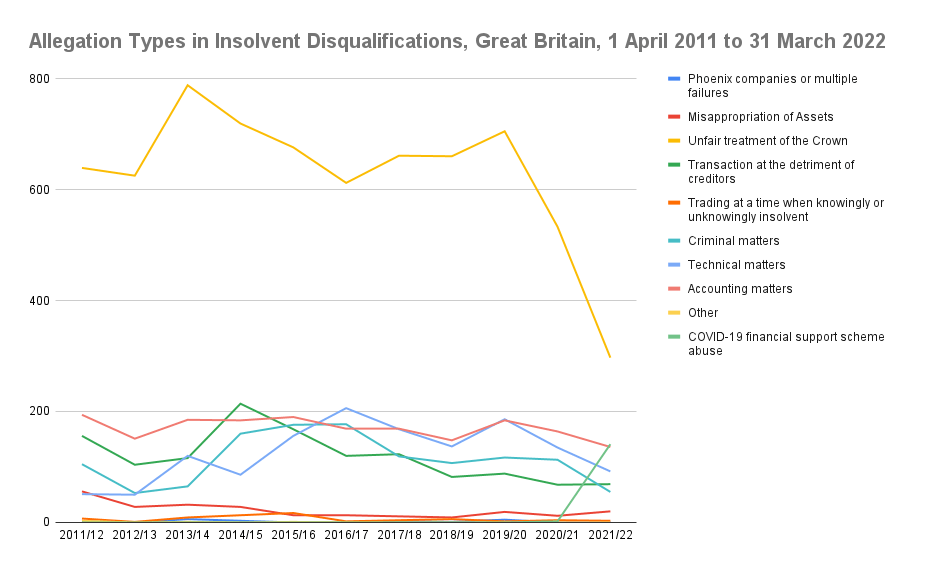
Examining the Insolvency Service Enforcement Outcomes 2021/22 shown in the graph above for the 11 years to 31 March 2022, there do not appear to have been any significant numbers of Director disqualifications identified as arising from Directors who have undertaken Pre Liquidation Pre Pack asset transfers.
It is perhaps to be expected if a Director has obtained an independent valuation and paid full market value for the company’s assets pre Liquidation notwithstanding the technical breaches, given the apparent absence of a loss it would seem unlikely to have been a material cause of Director Disqualifications. More likely would be such matters that caused insolvency in the first place.
We can see from the graph above that a significant proportion of Director disqualifications in recent years have resulted from unfair treatment of HMRC (Crown). This is explained in the government’s Guide to Insolvency Service Enforcement Outcomes summarising the types of allegations that culminate in Director Disqualification. It can be noted that Technical Matters causing disqualification does not mention the sort of breaches we are concerned with in the post:
Technical matters include persistent breaches of regulations regarding the duty to file accounts or returns with Companies House as well as persistent failure to file tax returns. Other matters covered by this allegation are breaches of regulations, such as those relating to financial services, employing illegal workers or failing to safeguard tenants’ deposits.
Preference Problem
A notabley serious issue that does arise when a Director transfers assets to a new entity pre Liquidation by way of an agreement to pay full market value is that of the insolvency Preference.
An insolvency Preference transaction arises when a person is a creditor of a company that goes into insolvent Liquidation and that person is put into a better position than they otherwise would have been had the transaction not taken place.
If a company Director is owed money by the company and organises a Pre Liquidation Pre Pack whereby they seek to offset the consideration they had to pay for the assets against their loans to the company, then that would amount to a Preference. It would be unlawful and it would be set aside by a Liquidator. The Director would not typically lose their right to claim as a creditor of the company but they would need to pay the full consideration for the assets or alternatively hand them back to the company and its Liquidator.
Oliver Elliot Observation
The Pre Liquidation Pre Pack is an issue that seems to have some perceptional problems similar to the concerns that sprouted over the years about Pre Pack Administrations.
However, where does a Director draw the line? If a company urgently needs an infusion of cash and a Director for example only, purchases the company car then if rules were to reduce his or her discretion, perhaps the Director’s ability to act in the interests of creditors could be unhelpfully fettered.
If a Director pays full market value for the company’s business and assets then generally it might appear to be the case that there would be no loss suffered by creditors. A Director who embarks upon such a process notably does however appear affected by difficult technical hurdles and legal obstacles that seem to be insurmountable. That said there appears no real evidence they would have to put the company into a better position than what a Liquidator would have achieved if their conduct was challenged at a later date.
However, a Director who strays into this course of action would be well advised to take professional advice because the potential technical and legal contraventions are certainly not trivial matters. Furthermore, if there was for example a competing purchaser which could have led in effect to an auctioning of the business and its assets, then a Liquidator may well be able to prove a loss has resulted and sue the Director for misfeasance accordingly for compensatory relief.
Are you a UK company Director?
If you are a Director of an insolvent company or a bankruptcy, Oliver Elliot can help you. We Know Insolvency Inside Out.

Share This Page!
What Next?
Expert Advice Is Just A Click Away
If you have any questions in relation to Pre Liquidation Pre Pack – Do The Rules Need Tightening Up On Asset Transfers To Directors? then contact us as soon as possible for advice. Oliver Elliot offers a fresh approach to insolvency and the liquidation of a company by offering specialist advice and services across a wide range of insolvency procedures.
Our expertise is at your fingertips.
Disclaimer: Pre Liquidation Pre Pack – Do The Rules Need Tightening Up On Asset Transfers To Directors?
This page is not legal advice and should not be relied upon as such. This article Pre Liquidation Pre Pack – Do The Rules Need Tightening Up On Asset Transfers To Directors? is provided for information purposes only. You can contact us on the specific facts of your case to obtain relevant advice via a Free Initial Consultation.
Recent Posts / View All Posts