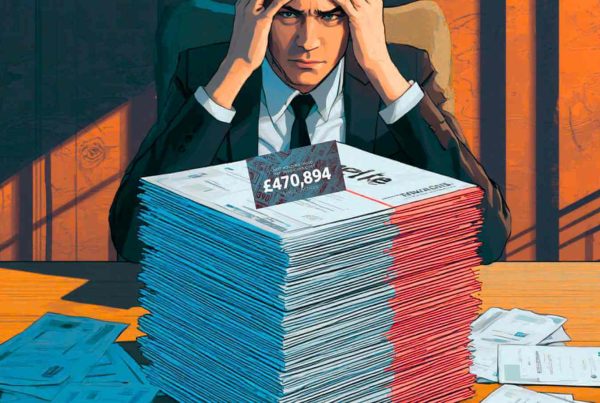
How Taxpayer Set Aside All HMRC Tax Assessments In The Tax Tribunal
The case of Chisovalandis Georgiou v Revenue & Customs [2022] UKFTT 455 (TC) is one that shows how taxpayer set sside all HMRC tax assessments. HMRC was unsuccessful in stopping the taxpayer from appealing against a whole range of assessments, including a Personal Liability Notice.
This case has the appearance of a most unfortunate lugubrious tale.
In this case, the burden was on HMRC to prove its case. The Tax Tribunal essentially suggested that HMRC had failed to satisfy the evidential threshold and was critical of HMRC’s approach.
Company Records
Before we descend into some of the highlights from the judgment a word about books and records a company must keep. An HMRC enquiry kicked off in January 2016 and the VAT assessment sprouted on 4 December 2017 for alleged undeclared output VAT and other assessments followed in respect of other taxes shortly thereafter. Once the assessments had landed the long trawl to Tribunal in effect began with judgment not handed down until 5 December 2022.
So what?
Well, the case was not resolved until five years after the VAT assessment was first raised. The business was a cash business and this case highlights the benefit of ensuring that your company records in such a business are in tip-top condition so that you can evidence with alacrity that which HMRC might require upon an enquiry being opened.
Hindsight may be a wonderful thing but if the company had kept its records differently then it is possible some of its issues may not have arisen. Although the Tribunal found that the taxpayer had acted properly that does not change the fact that HMRC did not think this was the case and whilst the taxpayer prevailed it took five years and perhaps at a not inconsiderable cost to deal with the enquiry.
The case involved a company called Georgiou & Co Limited (“the Company”) was insolvent and went into Voluntary Liquidation on 23 March 2018. The Company had various fish and chip shops.
The VAT Enquiry
The HMRC VAT enquiry got out of the starting blocks in January 2016 which sparked the other assessments and determinations.
Cash was a significant feature of the business with all sales being for cash and issues with the tills meant that there were some problems with the Company’s records. HMRC considered that the takings had been suppressed and it raised an assessment for VAT.
HMRC Surveillance
As part of the HMRC tax enquiry, it conducted surveillance of two of the fish and chip shops on two weeknights in November 2017 between 5 pm and 10 pm observing sales activities. The HMRC officer responsible for the VAT assessment accepted that it was based only on the information discovered in the surveillance operations in November 2017 which were then used to formulate the figures:
Mr Beard agreed in cross-examination that the assessment was based solely on the covert invigilations and that the figures produced were then extrapolated over the four year period of trading.
The second night of the surveillance was when the Company was no longer owner of the business.
The HMRC officer accepted this was not ideal.
There were quite a number of other instances in which the Tribunal was critical of the HMRC methodology used to arrive at the VAT assessment and assumptions HMRC had made:
192. It cannot be said that the two nights in November were representative of the whole period of trading. Apart from the disruption to the business caused by the death, the shedding of two shops, the seasonal variations, the differences between Dove House and Harvey’s, the differences between transaction numbers on different days during the week and at the weekend and the efficiencies implemented, sales can vary for many random reasons. The weather, holidays, a big football match on the television and many other contingencies can affect the sales on a particular day. To say that the observed sales on two nights, five nights apart is representative of the whole period is unrealistic.
193. Nor does Mr Beard appear to have stood back and considered overall if his conclusions were credible. We expect a general “reality check” to be part of exercising best judgement and this is indeed part of HMRC’s instructions to its officers. At VAEC 1510, which is headed “Best Judgement: Determine the overall credibility of your assessment”, it states:
“Once you have calculated the arrears to best judgement, you should ask yourself is this figure credible? Could the business have actually under-declared this amount of tax.
The tribunal will consider the above questions. If the amount you calculate does not pass the credibility test then your assessment may not be to best judgement. Ensure you have given enough consideration to all the facts and evidence.”
…
203. When we asked Mr Beard whether he had considered whether the business was in fact a loss making enterprise as the Appellant said, he was evasive in his reply. Taking into account his evidence and attitude it seems that, following the cash reconciliations which “suggested” the suppression of sales and purchases, he concluded that was the case and interpreted all the information provided and other evidence in a way which supported that conclusion.
204. We do not consider that the criteria for best judgement have been met. In particular, we do not consider that all the information provided was properly considered, there were flaws in the arithmetic and importantly, the sampling technique was far from representative. Having calculated the figures for the assessment, Mr Beard then failed to consider whether they were credible and whether the business could actually have underdeclared that amount of tax.
205. Having taken all the above into account, we conclude that the VAT assessment was not to best judgement and the assessment is accordingly invalid and cannot stand.
Corporation Tax Penalties
Another HMRC officer dealt with corporation tax penalties but the Tribunal in assessment of the matter of deliberate behaviour by the taxpayer alleged by HMRC had this to flesh out:
256. As the assessments and determination have failed, the penalties fall away. However, we observe that in determining that the behaviour was deliberate, Ms O’Connor simply cut and pasted Mr Beard’s reasons set out in the VAT penalty assessments and did not come to her own conclusion on this matter. For the reasons set out above, we have concluded that Mr Georgiou’s behaviour was not deliberate and HMRC have not shown, on the balance of probabilities, that it was careless.
257. The reductions for “telling”, “helping” and “giving” also followed those in the VAT penalty assessment and were not tailored to the corporation tax enquiry. As noted, Ms O’Connor did increase the reduction for telling as she had, in fact, only asked about the director’s loan account.
Directors Loan Account Section 455 Tax Charge
HMRC suggested that the Company’s Director, Mr Georgiou took around £1 million, out of the Company over four years without paying tax but it made quick work of pouring cold water over that proposition:
260. Ms Parlour submitted that where cash which has not been accounted for, is extracted from the company by a participator or participators and does not appear in the company accounts, then the participator(s) incur a debt to the company in common law and this creates an overdrawn director’s loan account subject to a tax charge under section 455. We agree with this general proposition.
261. HMRC allege that Mr Georgiou took the best part of £1 million, tax free, out of the Company over a four year period. That is the total of the alleged omitted sales, somehow extracted from the cash takings. As noted, Mr Georgiou was only responsible for the finances of the Company following the death of his father in any event. Even if sales were undeclared (and HMRC have not proved this on the balance of probabilities) HMRC have not produced a shred of evidence that any money was taken by Mr Georgiou for his own use. Ms O’Connor admitted that she did not look at Mr Georgiou’s lifestyle or carry out any sort of credibility check, such as an examination of personal bank statements for suspicious deposits, to consider whether he had taken the money. She had taken the view that the money from the assumed omitted sales as calculated in the VAT assessment must have gone somewhere and by default, she assumed that the director took it for his own use.
262. This does not discharge the burden of proof and the assessment made under section 455 Corporation Tax Act 2010 must fail.ever, the Tax Tribunal
Oliver Elliot Observation: How Taxpayer Set Aside All HMRC Tax Assessments
No doubt this is a case both the taxpayers and HMRC will want to forget. Whilst there was some criticism of HMRC in this case it is worth noting that a person who investigates is looking at matters with a fresh pair of eyes without first hand knowledge.
If they cannot unscramble a matter with relative ease from contemporary records then the possibility will be that assumptions may risk filtering in and sometimes may even inadvertently become elevated as fact in the mind of the investigator.
Are you a UK company Director?
If you are a Director of an insolvent company or a bankruptcy, Oliver Elliot can help you. We Know Insolvency Inside Out.

Share This Page!
What Next?
Expert Advice Is Just A Click Away
If you have any questions in relation to How Taxpayer Set Aside All HMRC Tax Assessments then contact us as soon as possible for advice. Oliver Elliot offers a fresh approach to insolvency and the liquidation of a company by offering specialist advice and services across a wide range of insolvency procedures.
Our expertise is at your fingertips.
Disclaimer: How Taxpayer Set Aside All HMRC Tax Assessments
This page is not legal advice and should not be relied upon as such. This article How Taxpayer Set Aside All HMRC Tax Assessments is provided for information purposes only. You can contact us on the specific facts of your case to obtain relevant advice via a Free Initial Consultation.
Recent Posts / View All Posts