
Overview Of The Insolvency Practitioner Bond
An Insolvency Practitioner Bond is security for losses caused by fraud and dishonesty.

An Insolvency Practitioner Bond is security for losses caused by fraud and dishonesty.
An Insolvency Practitioner will not be qualified to act in relation to a company or individual unless there is in force security (in Scotland this is called caution) for the proper performance of the practitioner’s functions. The security must meet the prescribed requirements as defined in the Insolvency Practitioners Regulations 2005 (as amended by the Provision of Services (Insolvency Practitioners) Regulations 2009.
The security, which is referred to as a bond, must be approved by the Secretary of State. The bond makes the surety (the insurer who issued the bond) jointly liable with the insolvency practitioner for losses in relation to the insolvent estate caused by the fraud or dishonesty of the insolvency practitioner (whether acting alone or in collusion), or the fraud or dishonesty of any person committed with the connivance of the insolvency practitioner. The bond is not a form of professional indemnity insurance and does not provide cover against professional negligence.

A bond comprises two main elements of cover, a general penalty sum (also referred to as an enabling bond) and a specific penalty sum.
This provides cover up to an amount of £250,000, and is generally renewed every 12 months. The bond, or a copy of it, is lodged with the insolvency practitioner’s authorising body and can be called upon if the Insolvency Practitioner fails to obtain specific penalty sum cover in respect of an insolvency appointment, or where the specific penalty sum cover obtained is insufficient.
Specific penalty sum cover is required in respect of each insolvency appointment generally for an amount not less than the estimated value of the insolvent’s asset. Where the estimated assets are worth less than £5,000, the specific penalty sum cover must be at least £5,000. The maximum amount of specific penalty sum cover for any one case is £5 million. Where appointments are taken jointly with another insolvency practitioner all appointed office-holders must have their own cover for the full value (subject to the limits referred to above) of the insolvent’s assets.
The level of the bond cover required is set out in Paragraph 4 of Schedule 2 of the Insolvency Practitioner Regulations 2005:
4. Subject to paragraphs 5, 6 and 7, the amount of the specific penalty in respect of a case in which the insolvency practitioner acts, shall equal at least the value of the insolvent’s assets as estimated by the insolvency practitioner as at the date of his appointment but ignoring the value of any assets—
(a) charged to a third party to the extent of any amount which would be payable to that third party; or
(b) held on trust by the insolvent to the extent that any beneficial interest in those assets does not belong to the insolvent.
An Insolvency Practitioner is required to maintain a record of cases in which they are acting and the value of the insolvents’ assets which they submit to the bond provider – this is known as the cover schedule. The terms of the bond will dictate the date by when it is to be submitted but, in practice, this is generally monthly. The cover schedule will include information about:
The schedule is required to be submitted to the Insolvency Practitioner’s authorising body not later than 20 days after the end of the month to which the schedule relates. Where no schedule is submitted in relation to the month, a statement confirming a ‘nil return’ or a statement that it is not practicable to supply particulars should be made.
The Insolvency Practitioner is required to keep a copy of the schedule submitted by them for a period for two years after their release or discharge from the case. A copy of the schedule is required to be produced for inspection by:
The beneficiary of the bond is the Insolvency Practitioner’s authorising body on behalf of the creditors of the defrauded estate. In practice the authorising body generally assigns the benefit of the bond to another Insolvency Practitioner who is appointed office-holder in place of the Practitioner whose bond is the subject of a claim and pursues a claim against the bond on behalf of creditors.
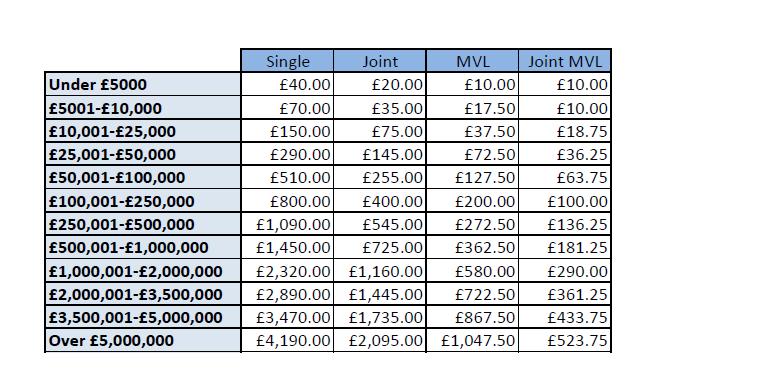
The following are the currently applicable Specific Bond Rates for Oliver Elliot Limited:
For a free no obligation chat about any of the matters detailed above, please do get in touch for help. An expert will call you back or if you prefer exchange emails.
We can explore your situation and consider the best way to help you and your business needs. You can call us 020 3925 3613 or fill in the form below and will get back to you quickly. We Know Insolvency Inside Out.
If you have any questions in relation to What Is The Insolvency Practitioner Bond? then contact us as soon as possible for advice. Oliver Elliot offers a fresh approach to insolvency and the liquidation of a company by offering specialist advice and services across a wide range of insolvency procedures.
This page is not legal advice and is not to be relied upon as such. This article What Is The Insolvency Practitioner Bond? is provided for information purposes only. You should take independent advice on the facts of your case. No liability is accepted for reliance upon this post.




Oliver Elliot is a specialist firm set up by Elliot Green, who is a Licensed Insolvency Practitioner and Chartered Accountant. We know insolvency inside out. We offer a vast variety of services and can accommodate you no matter what industry you are in and what insolvency services you require. Where there’s Oliver Elliot there’s a way.



© 2026 Oliver Elliot. All Rights Reserved. Registered in England and Wales. Company Number: 11746967

