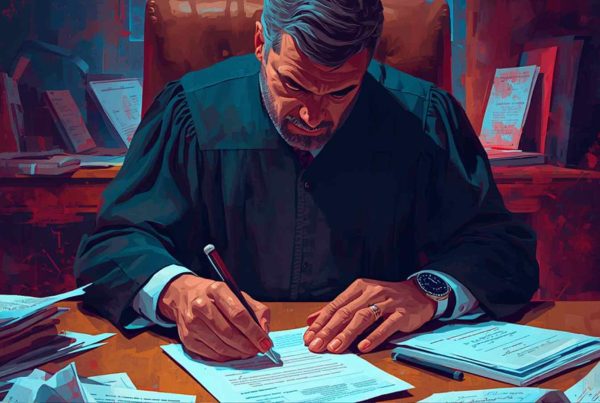
A company Director is facing a Director Wrongful Trading liability order in the sizeable sum £90,513.10 after a Trial in the High Court in April this year (2023). Sabir Esa, who did not attend Trial, was ordered to pay £136,858.89 following a decision fleshed out by by Insolvency and Companies Court Judge Mullen on 31 July 2023.
In addition to £90,513.10 for Wrongful Trading he was told to pay the Liquidators a further £46,345.79 in respect of book debts taken over by a connected company Stone Key Limited the he controlled.
The matter, Merry & Ors v Esa (Re Safe Depot Ltd and Insolvency Act 1986) [2023] EWHC 2011 (Ch) related to the demise of Safe Depot Limited (“the Company”). It operated a storage space for rent business from three sites, two of which were transferred to Stone Key LImited during July or August 2016.
Judge Mullen found that by the end of September 2016, there was no reasonable prospect the Company would avoid insolvent Liquidation. It was not paying its business rates or rent in full, notwithstanding having agreed on a payment plan with the landlord. The Company went into Compulsory Liquidation on 24 July 2017.
In assessing the evidence Judge Mullen referred to the duty of a Director to show the proper purpose of a transaction that it appeared he (or a connected party) had the benefit of.
Director’s Burden Of Proof
At two Company locations, customer book debts of £14,061.98 and £15,763.81 were said to have been transferred to Stone Key Limited. The Judge said he was unable to find any evidence of consideration provided for the transfers or that Mr Esa had considered the interests of creditors whilst undertaking the transfers:
That being so the court has to consider the exercise of the duty objectively, applying the standard of the reasonable and honest director. He similarly placed himself in a position of conflict between his interests as a director and shareholder of Stone Key and his duty to the Company for the purposes of section 175 CA 2006.
A key legal principle that reasonably requires stamping into the heart of every Director’s duties textbook was recited by the Judge in reference to a Director’s receipt of company property:
…once the Liquidators have shown that Mr Esa or his corporate vehicle, Stone Key, received property of the Company, it is for him as a fiduciary to show the propriety of that receipt (GHLM Trading Limited v. Maroo [2012] EWHC 61, per Newey J, as he then was, at paras 148-9). Once the Liquidators have made out a prima facie case, it is not open to Mr Esa:
“to escape liability by asserting that, if the books and papers or other evidence had been available, [he] would have shown that [he was] not liable in the amount claimed”
(Re Mumtaz Properties [2011] EWCA Civ 610 per Arden LJ, as she then was, at paras.16-17). I bear those principles in mind.
Director Relief Of Liability Not Available
Notwithstanding a Director’s breach of duty, if a Director has acted honestly and reasonably then the Court may by virtue of Section 1157 of the Companies Act 2006 relieve them of an obligation arising in whole or part.
Not in this case said the Judge:
There is no basis to grant relief here. Mr Esa did not act reasonably. While he has maintained that he followed advice he has provided no evidence of such advice. There is no evidence that he have any real consideration to the propriety of the dispositions of the Company’s property at all.
As Ms Hallett also pointed out, in In Re Marini [2003] EWHC 234, at para. 57, His Honour Judge Richard Seymour QC, sitting as a judge of the High Court, noted that he would have the greatest difficulty in thinking it ever likely that it would be right for a defaulting director to be granted relief if the consequence of doing so would be to leave him enjoying benefits at the expense of creditors which he would never have received but for his default. The benefit of the Bury and Blackburn Businesses and the Birkenhead Debtors was here transferred to Stone Key, of which Mr Esa was sole director and sole shareholder. There is no basis on which it can be said that it would be fair to relieve him of the consequences of his breach of duty.
Oliver Elliot Comment

The reason why Directors need to keep company records is to explain and justify transactions. So serious is this that a failure to do so is a criminal offence pursuant to Section 387 of the Companies Act 2006.
In this case, the Liquidators complained large tranches of records appeared to be missing. This plainly neither assisted the Director nor the Court in its assessment of the Liquidators’ claims. In the end the Court it seems had to reflect upon the Director’s duty to keep records when determining the claims complained about.
For a free no obligation chat about any of the matters detailed above, please do get in touch for help. An expert will call you back or if you prefer exchange emails.
We can explore your situation and consider the best way to help you and your business needs. You can call us 020 3925 3613 or fill in the form below and will get back to you quickly. We Know Insolvency Inside Out.

Author: Elliot Green
Last Updated: October 18, 2026
Share This Page!
What Next?
Expert Advice Is Just A Click Away
If you have any questions in relation to Director Wrongful Trading Liability Results In A £90,513.10 Bill then contact us as soon as possible for advice. Oliver Elliot offers a fresh approach to insolvency and the liquidation of a company by offering specialist advice and services across a wide range of insolvency procedures.
Our expertise is at your fingertips.
Disclaimer: Director Wrongful Trading Liability Results In A £90,513.10 Bill
This page is not legal advice and is not to be relied upon as such. This article Director Wrongful Trading Liability Results In A £90,513.10 Bill is provided for information purposes only. You should take independent advice on the facts of your case. No liability is accepted for reliance upon this post.
Recent Posts / View All Posts