Concerned About Wrongful Trading If Company Enters Liquidation?
The answer to the question should I be concerned about Wrongful Trading if my company enters Liquidation? is yes but not simply because your company has gone into Liquidation. There has to be something a whole lot more involved by causing a loss to creditors due to Director neglect.
The risk of being accused of Wrongful Trading is sufficient to highlight it as a concern of many Directors. However, without seeking to trivialise what is a very serious matter for both creditors and Directors for different reasons, the reality is perhaps highlighted by Professor Andrew Keay in his paper Wrongful Trading: Problems and Proposals:
Arguably, it is easier for liquidators to make out cases under the adjustment provisions, such as preferences (especially against connected persons) and transactions at an undervalue, than under s.214.
Nevertheless, as a question put so frequently to Insolvency Practitioners, the effect of having it as part of the core insolvency legislation suggests it has sufficient impact to be of concern to company Directors.
What Is Wrongful Trading?
The mere fact that a company has gone into Liquidation is not sufficient to trigger the risk of Wrongful Trading. In the case of a solvent Liquidation known as a Members Voluntary Liquidation there is no risk of Wrongful Trading arising provided the company does not later go into an insolvent Creditors Voluntary Liquidation.
A company going into INSOLVENT Liquidation (or Administration in light of Section 246ZB of the Insolvency Act 1986) is the key requirement for Wrongful Trading to exist. Without a company going into such a formal insolvency procedure the risk of Wrongful Trading cannot arise.
Wrongful trading is the act by a Director of trading on whilst insolvent knowing that the company had no realistic prospect of avoiding insolvent Liquidation or Administration. However, Section 214 of the Insolvency Act 1986 provides a Director with a defence if they took every step to minimise the loss to creditors.
If a Director of a Limited Liability company is found to be guilty of Wrongful Trading then the Court may order they pay compensation over to the company’s Liquidator (the Insolvency Practitioner who runs the Liquidation) for the ultimate benefit of the creditors. The amount that might have to be paid in compensation should match the loss caused to creditors for the period of Wrongful Trading.
What Is The Risk Of Wrongful Trading Arising?
Directors concerned about Wrongful Trading because a company has gone into Liquidation (or subsequently goes into Liquidation) should of course be aware of the risk. However, the risk of Wrongful Trading increases when a Director overlooks their obligations to creditors to act in their interests when a company is insolvent and carries on trading making the situation for them worse. This is particularly the case when a Director does not inform creditors about what is happening, leaving them unaware only to find out later when it all goes pear-shaped.
Directors have a Director duties from the Companies Act to act in the interests of creditors in light of Section 172(3) of the Companies Act 2006 which says:
The duty imposed by this section has effect subject to any enactment or rule of law requiring directors, in certain circumstances, to consider or act in the interests of creditors of the company.
Is The Risk Of Wrongful Trading Overstated?
When a Director is sued by a Liquidator for Wrongful Trading the starting point are the tests for a Section 214 action. However, that is not the end of the story because the risk of a Wrongful Trading claim is not only borne by the Director(s). A Liquidator who sues a Director for Wrongful Trading does so at personal risk. If the Liquidator loses the case he or she will usually be liable to pay the Director’s legal costs. A Liquidator will therefore have to think long and hard before embarking upon such legal proceedings, not only putting themselves at such personal risk but also considering how they will fund their legal costs to bring the claim.
A Liquidator enters office as a stranger to the affairs of a company, having no prior first hand knowledge of what happened. There is always a risk TO THE LIQUIDATOR that notwithstanding what the evidence appears to show in the documents, that a Director will say something under examination in the witness box in Court that will exonerate them of the alleged Wrongful Trading.
Some notable research papers have queried the use of Wrongful Trading as a provision and appear to have highlighted its potential ineffectiveness. The title of some of these speak volumes as follows:
- Wrongful trading actions: smoke without fire David Milman
- Wrongful Trading: An Impotent Remedy? Richard Shulte
- No Compensation For Wrongful Trading – Where Did It All Go Wrong? Gabriel Moss’ QC
However, the possible ineffectiveness of the remedy has not arisen without attempts by Insolvency Practitioners to make use of it. Cases have been launched and quite a few have failed. Undoubtedly many will have settled and never made it to Court either because the case was overwhelmingly weighted one way or the other.
That said if a Director has buried their head in the sand and continued trading onwards after the point they ought to have done then the potential risk to him or her of being successfully sued for Wrongful Trading will go up significantly.
What Do The Statistics Show?
The risk of Wrongful Trading could perhaps be overstated based on the number of Directors who can readily be shown to have been sued in comparison with the number of company insolvencies each year.
Statistics in terms of the number of Wrongful Trading claims issued are not easy to assemble but the most readily available information can be obtained from published Court decisions.
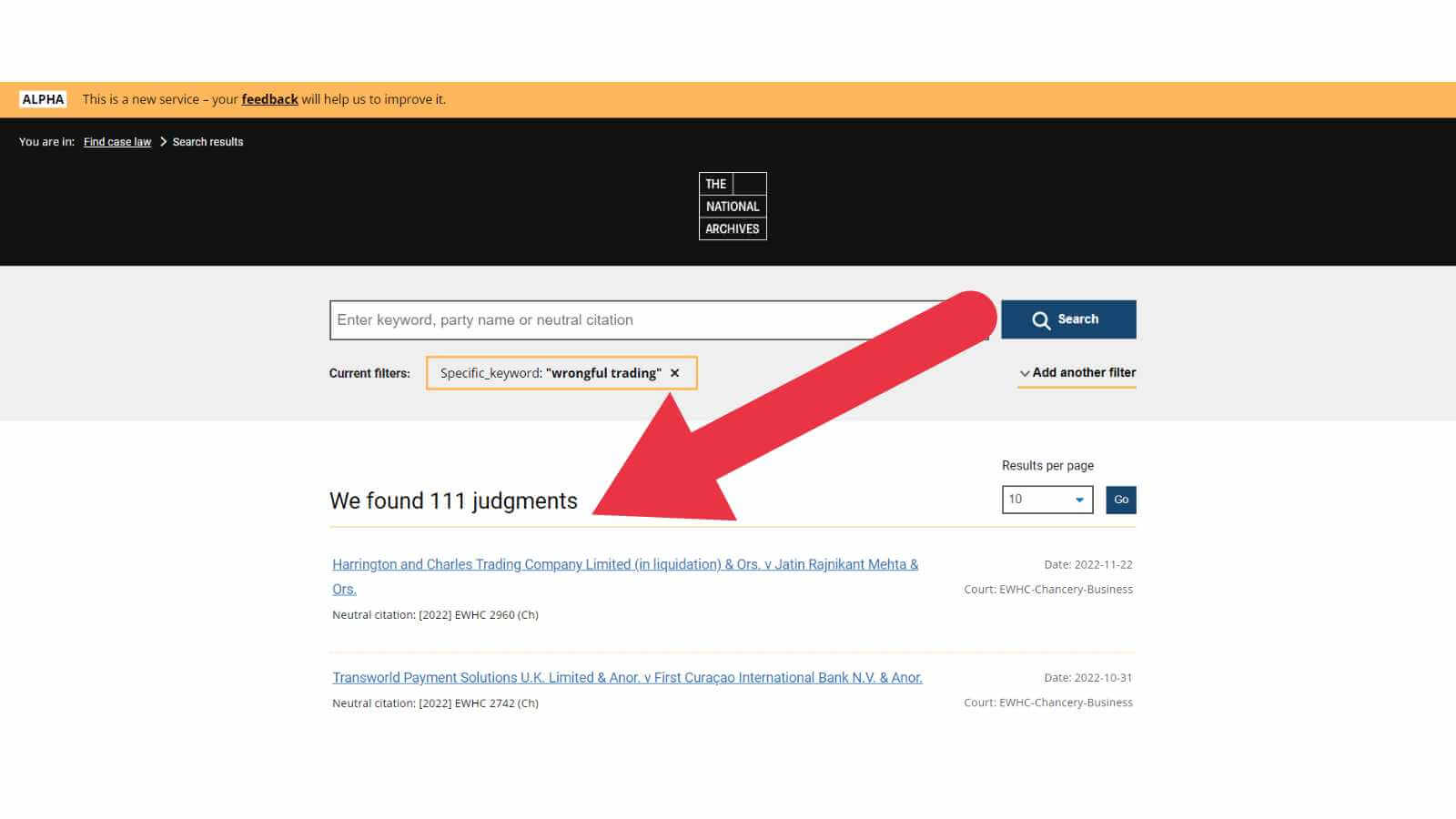
The nature of Wrongful Trading is such that it invokes strong feelings and interest such that a contested claim would likely feature in available judgments published by Bailii or The National Archives. Neither of these two libraries list all judgments issued by any means and few of their published decisions will relate to cases where the Courts have issued unwritten judgments. However, given the nature of a contested Wrongful Trading claim and its difficulties a) most of them are likely to be written and b) most of them are likely to have been published by these two online facilities.
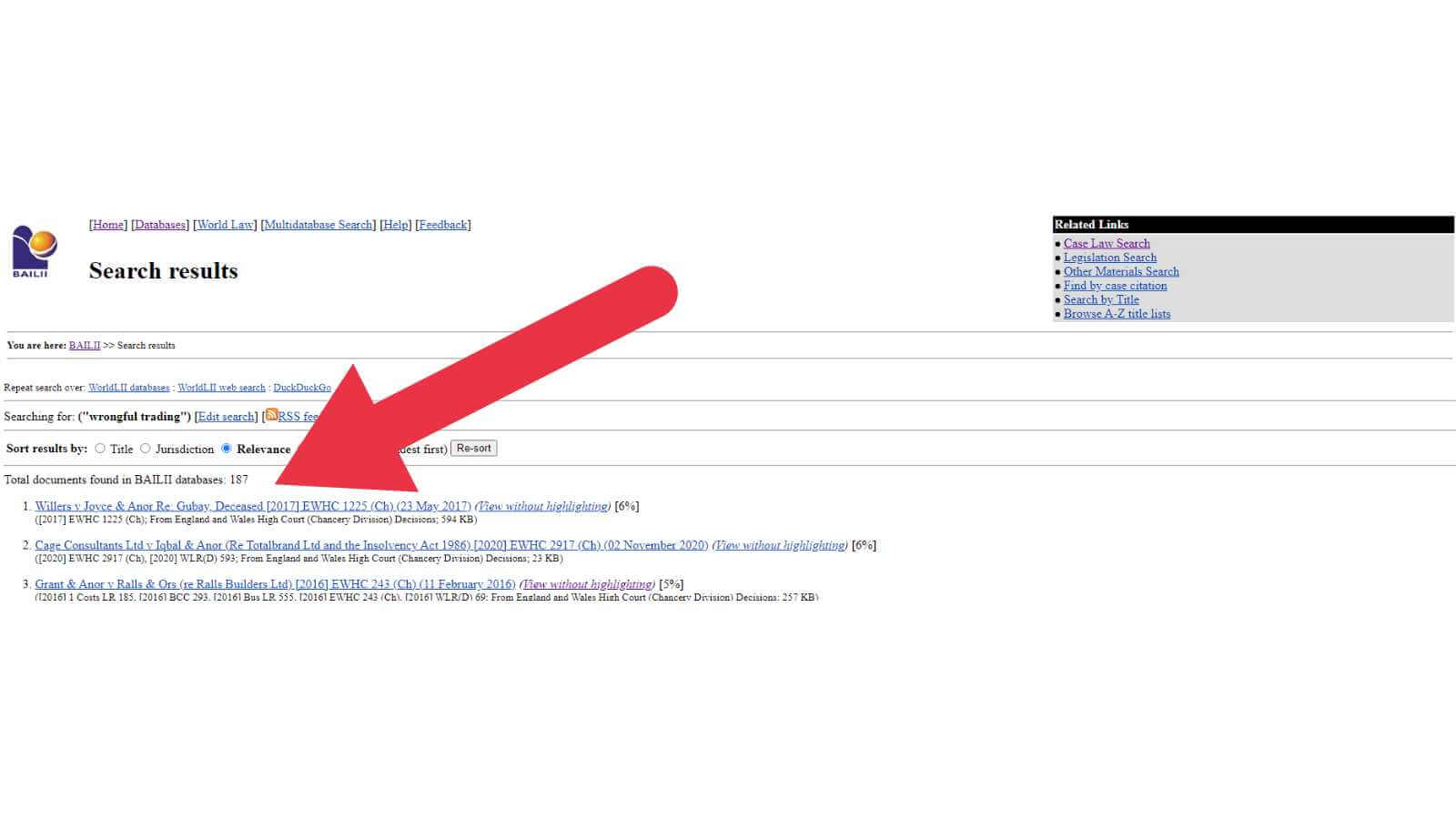
If you search the words “Wrongful Trading” in Bailii you end up with the following showing 187 results: