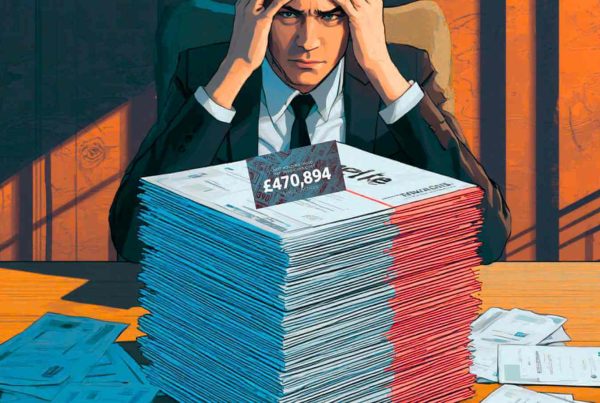
Overview Of HMRC Penalties For Careless Or Deliberate Errors
HMRC penalties for careless or deliberate errors is a regime based on whether the taxpayer has behaved in a manner that it assesses as ‘careless’, ‘deliberate’, or ‘deliberate and concealed’.
This is an escalating scale and the more concerning the taxpayer’s conduct is considered to be based on these three categories then the larger the penalty HMRC is likely to levy. Careless conduct is less serious than deliberate and by definition, deliberate and concealed conduct is more serious than deliberate.
The HMRC penalty regime can result ultimately in criminal proceedings with the intention that upon indictment the taxpayer will serve time at His Majesty’s pleasure.
HMRC issues huge numbers of financial penalties each year. In comparison, relatively few people are imprisoned.
What Is Careless Conduct?
For most people, a tax return is accepted by HMRC and does not lead to an HMRC tax investigation.
The tax regime is structured as a self-assessment. The taxpayer in the first instance assesses their own tax position and puts in a return. Only if HMRC has concerns or disagrees would an HMRC investigation arise whereby the penalty regime might be invoked.
If HMRC assesses the taxpayer has been careless then although the tax return information would appear incorrect, HMRC considers that the intention was not to mislead. As a result, careless conduct results in far lower penalties than more serious deliberate conduct.
Carelessness is a form of neglect and a penalty will typically arise from that because it is a legal requirement to ensure the taxpayer keeps their HMRC tax affairs in proper order.
Whenever HMRC levies a penalty it has to show that an error has arisen. The burden is on HMRC not on the taxpayer to prove (on the balance of probabilities) that the conduct complained about was careless. The article What Is HMRC Tax Carelessness? which involved a Tax Tribunal case showed that the taxpayer has to take reasonable care or else they can be held to have been careless.
This position is consistent with HMRC internal manual Compliance Handbook CH54300 – Assessing Time Limits: Onus of proof and level of proof that states:
The onus of proof of careless or deliberate behaviour is on HMRC… The level (or standard) of proof is the balance of probabilities.
How Does HMRC Penalise Carelessness?
HMRC will assess carelessness based on the amount of tax at stake for a given tax year.
Although all people are supposed to be granted equal treatment in law HMRC nevertheless will typically hold a taxpayer who should have specialist knowledge such as a qualified accountant to a higher standard than someone of a wholly unrelated skillset such as a taxi driver.
Illness that is provable can be taken into consideration.
Carelessness will result in a tax penalty charged at 0-30% of the lost tax.
What Is Deliberate Conduct?
Deliberate conduct is more serious than carelessness.
It suggests a decision has been intentionally taken to either provide incorrect information to HMRC or to prevent HMRC from discovering the true position due to information being withheld.
There is a taxpayer duty to come clean to HMRC. As a result, providing false and misleading information or withholding it is not acceptable.
HMRC’s Compliance Handbook Manual CH81150 – Penalties for Inaccuracies: Types of inaccuracy: Deliberate but not concealed inaccuracy says:
A deliberate but not concealed inaccuracy occurs when a person gives HMRC a document that they know contains an inaccuracy. It is not necessary to demonstrate that the person knew what the accurate figure was, only that they knew that the figure they put on the document was not accurate.
HMRC’s Approach To Penalties For Deliberate Mistakes
Unsurprisingly where a taxpayer has deliberately decided to mislead HMRC or withhold information that is not treated sympathetically. HMRC will typically come down heavily on such a taxpayer. This will be reflected in the penalties it levies which can range from 20-70%.
Unprompted disclosure by a taxpayer will usually enable the penalty to be at the lower end of the scale compared to the taxpayer who does not hold up their hands and leaves it to HMRC to discover matters.
HMRC has access to lots of information that it can assemble and be prompted for inconsistencies. For example, where a person’s salaries are referred to in a self-assessment tax return this can be compared to real time information. In respect of companies, HMRC can look for inconsistencies between VAT returns filed electronically and the accounting information used to support a corporation tax return. It is to be expected therefore that HMRC will have available to its investigation teams a whole stream of exception reports that highlight anomalies that warrant review.
As with any penalties that HMRC wishes to levy, it shoulders the burden of proof to prove that the conduct it complains about is deliberate.
In the case of Dolan v Revenue & Customs (Income Tax – Self-assessment – Penalties) [2020] UKFTT 448 (TC), the taxpayer Simon Dolan was able to show the Tax Tribunal his actions were at worst a careless not deliberate error on a tax return because there was no intention to mislead HMRC and he accepted the position when his error was highlighted.
HMRC’s Penalties For Deliberate Errors
Where HMRC finds evidence of fraud, they do not hesitate to impose significant tax penalties.
Deliberate Errors and Failures to Notify will result in penalties of 20% to 70% of any revenue HMRC may have lost. If you tell HMRC unprompted, help it work out the amount of tax in question and provide access to records then you may find yourself at the lower end of the penalty spectrum.
If there is offshore tax involved then penalties can rocket up to 200%.
HMRC’s Approach To Penalties For Deliberate And Concealed Errors
Deliberate and concealed errors will involve conduct in which steps are taken to mislead and cover up the position. Documents could be forged for instance or the true nature of transactions and their purpose misrepresented to HMRC. In the case of trading businesses, any positive steps specifically taken to reduce turnover or falsify expenses so the level of profit is reduced to lessen tax liabilities could constitute deliberate and concealed conduct.
HMRC’s Penalties For Deliberate And Concealed Errors
Where the taxpayer makes unprompted disclosure, HMRC will charge 30% to 100% of the lost tax. However, as is common with deliberate and concealed tax errors, HMRC takes a notably tough stance and will charge a penalty between 50% to 100%.
HMRC Prosecutions
In most cases rather than commence criminal proceedings HMRC’s prosecutions are in effect downgraded using what is known as a Code of Practice 9 procedure (“COP 9”).
The COP 9 procedure offers the taxpayer who is suspected of fraud an alternative to facing criminal prosecution by HMRC. However, to avoid this the taxpayer must make full disclosure of their affairs within 60 days. In the most serious cases, however, a COP 9 procedure will not be available and matters will proceed straight down the lines of a criminal investigation.