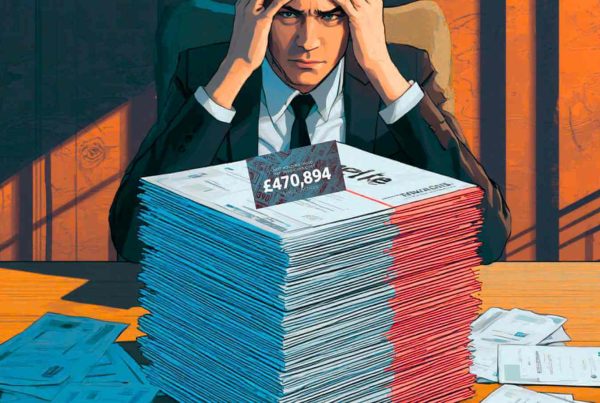
There are occasions when tax law achieves something seemingly rather remarkable: it manages to be perfectly logical and yet may arguably produce some inconsistency at the same time.
The recent Upper Tribunal decision in HMRC v Quillan [2026] UKUT 300 (TCC) appears perhaps to produce such an example. If nothing else, it may leave an anomaly to be addressed.
That decision overturned the position in Quillan v Revenue and Customs [2025] UKFTT 421 (TC) (11 April 2025). The first decision was reported in our post, HMRC Lose An Overdrawn Director’s Loan Account Write-Off Case.
The case concerned an overdrawn director’s loan account and whether it had been “written off” for the purposes of Section 415 of the Income Tax (Trading and Other Income) Act 2005.

Two Tribunals, Two Answers, Both Entirely Plausible
The First-tier Tribunal had seemingly taken a rather sensible view that, since the liquidator had not formally written off the loan and there remained a possibility of recovery if the company were restored, HMRC had not established that the necessary write-off had occurred.
The Upper Tribunal disagreed.
It concluded that the write-off had effectively occurred when the liquidator submitted the final account in the creditors voluntary liquidation.
No grand declaration of forgiveness was required. No ceremonial burning of the debt. No parchment, quill and suitably sombre music.
The liquidation itself was enough.
So far, so straightforward.
And this is where the case becomes rather delicious.
You can read the First-tier Tribunal decision and nod Solomonically. Then read the Upper Tribunal decision and nod Solomonically yet again.
Like a well-trained nodding dog on the dashboard, you find yourself agreeing with both.
Then Comes the Awkward Question
Suppose the director pays the resulting income tax charge.
Then, at some later point, the loan is repaid to the company.
What happens to the tax?
That is where the elegance of the system begins to resemble something conceivably akin to a Victorian plumbing arrangement.
The apparent consequence is that the taxpayer may have paid income tax on money which is subsequently returned to the company, without any obvious mechanism for recovering the tax already paid.
In other words, the taxpayer can potentially be taxed on money he ultimately no longer has.
This is an achievement of sorts: a provision designed to root out tax avoidance appears capable of producing its own curious inversion, tax appreciation.
The Taxman Gets His Money. The Company Gets Its Money. The Taxpayer Gets the Bill.
The Upper Tribunal appeared to recognise the potential unfairness and suggested that the matter might warrant legislative amendment or an extra-statutory concession.
But it declined to rewrite the legislation itself.
Judges interpret Acts of Parliament. They do not get to wander into the legislative kitchen and alter the recipe because the pudding has emerged looking faintly concerning.
And so we are left with an apparently rather delicious paradox.
The First-tier Tribunal’s approach potentially risked allowing directors to personally escape tax because a loan had not been formally written off.
The Upper Tribunal has closed that escape hatch.
But in doing so, did it potentially now open another tricky trapdoor in which a director pays tax on a loan that is subsequently repaid?
The state gets its tax. The company gets its money. The taxpayer gets the bill.
Nobody has necessarily done anything improper, yet somehow the citizen may emerge poorer, and the machinery could congratulate itself on having functioned correctly.
Nobody Has Done Anything Wrong. And Yet Here We Are.
The Upper Tribunal has done what courts are supposed to do.
HMRC has done what HMRC is supposed to do.
The legislation has done what the legislation says.
Which leaves only one remaining question:
When everyone has followed the rules and the result still looks potentially concerning, perhaps the problem is not the taxpayer. Could it be the rules?
Perhaps Parliament may wish to investigate before someone accidentally suggests taxing the repayment as well?

For a free no obligation chat about any of the matters detailed above, please do get in touch for help. An expert will call you back or if you prefer exchange emails with you on the subject.
We can explore your situation and consider the best way to help you and your business needs. You can call us 020 3925 3613 or fill in the form below and will get back to you quickly. We Know Insolvency Inside Out.


Author: Elliot Green
Last Updated: October 18, 2026
Share This Page!
What Next?
Expert Advice Is Just A Click Away
If you have any questions then contact us as soon as possible for advice. Oliver Elliot offers a fresh approach to insolvency and the liquidation of a company by offering specialist advice and services across a wide range of insolvency procedures.
Our expertise is at your fingertips.
Disclaimer
This page is not legal advice and is not to be relied upon as such. This article is provided for information purposes only. You should take independent advice on the facts of your case. No liability is accepted for reliance upon this post.
Recent Posts / View All Posts