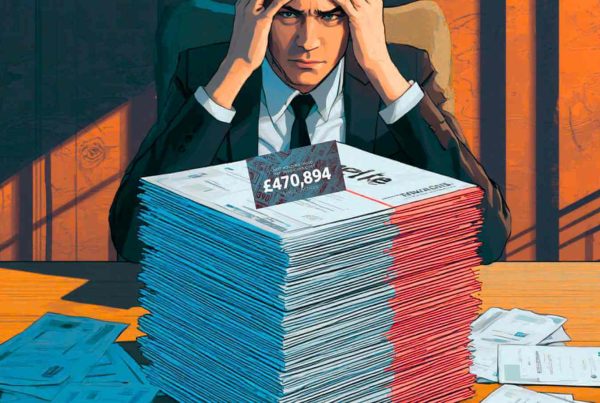
Is an overdrawn director’s loan account tax avoidance? No, an overdrawn director’s loan account is not tax avoidance but the operation of the loan account year on year could be.
An overdrawn director’s loan account for most limited companies should be part of the natural relationship between a company director of an owner managed business and their companies. However, when it is deployed as a means of extracting funds from a company instead of taking dividends or salary and the loan is seemingly not repaid that tax issues such as tax avoidance can conceivably arise.
A problem is an overdrawn director’s loan account can be triggered by the desire to avoid or even delay tax. If a director would ordinarily have taken a salary from a company to live off as opposed to loans from it then the company would be paying over to HMRC their PAYE and National Insurance Contributions taxes whenever they were paid (often each month). Not for example 9 months after the company’s year end when Section 455 tax kicks in if any such loans are not repaid within 9 months and 1 day of the year end.
However, the most common issue of overdrawn director’s loan accounts being a feature of tax avoidance relates to the recycling of director loans to seek to escape the Section 455 tax charge. More about that later.
What Is Tax Avoidance?
Tax avoidance is applying the rules to obtain a tax advantage they did not intend. HMRC sets out its meaning of tax avoidance in its guide tax avoidance an introduction as follows:
Tax avoidance involves bending the rules of the tax system to try to gain a tax advantage that Parliament never intended.
It often involves contrived, artificial transactions that serve little or no purpose other than to produce this advantage. It involves operating within the letter, but not the spirit, of the law.
Unlike tax evasion, it is not illegal in terms of cheating the revenue which is a criminal offence but it can be conduct that gives rise to a liability to pay tax, penalties and interest. This is particularly the case if a tax avoidance scheme is a series of preordained steps with no other purpose or rationale other than the avoidance of tax to be paid to HMRC.
A common example in recent years of such a scheme is an Employee Benefit Trust. Such schemes may have involved a series of circular transactions and loans as a means to operate what HMRC often considered to be disguised remuneration. This was clamped down on by HMRC.
What Are The Tax Implications Of An Overdrawn Director’s Loan Account?
If an overdrawn amount is not repaid within nine months and one day of the end of the company’s accounting period, the company will face the Section 455 tax charge at the rate of 33.75% of the outstanding loan amount.
It can also trigger a benefit in kind when the director’s overdrawn position exceeds £10,000 at any point during the year. A company director must pay personal tax on the loan as if it were additional salary or dividends.
If the director has not been charged interest on the loan by the company according to the beneficial loan arrangements, the director may be liable to pay tax on the benefit equivalent to the difference between the official rate and the actual interest rate charged.
How Can An Overdrawn Director’s Loan Account Amount To Tax Avoidance?
An overdrawn director’s loan account is not inherently tax avoidance, but it can be perceived as a mechanism to defer tax payments or extract funds from the company in a tax efficient manner.
Directors may temporarily borrow money from the company for personal reasons with the full intention of repaying it promptly. As long as the loan is repaid according to the rules, and all necessary taxes are paid, this would appear to be a legitimate use of a director’s loan account.
However, when an overdrawn director’s loan account sits on a company’s balance sheet year on year and a Section 455 tax charge is not paid or it has not been treated as a benefit in kind, then tax avoidance could well be the reason.
Is Recycling An Overdrawn Director’s Loan Account Tax Avoidance?
Recycling an overdrawn director’s loan account is certainly capable of falling within the ambit of tax avoidance.
The technique of repaying the overdrawn director’s loan account just within 9 months of the year end and then whipping it out again year after year is treated as tax avoidance. Indeed as a result a provision to prevent what is known as bed and breakfasting was introduced in Section 464C of the Corporation Tax Act 2010. The effect is that if an overdrawn director’s loan account was repaid but then over £5,000 is taken back and within 30 days of the period end, the repayment is for tax purposes offset against the subsequent loan, not the former loan and a Section 455 tax charge kicks into effect.
Although not so simple to prove for HMRC, where the original loan was £15,000 or more then ignoring the 30 day position if it can be shown there was an intention to retake a loan of at least £5,000 then the Section 455 charge still sprouts.