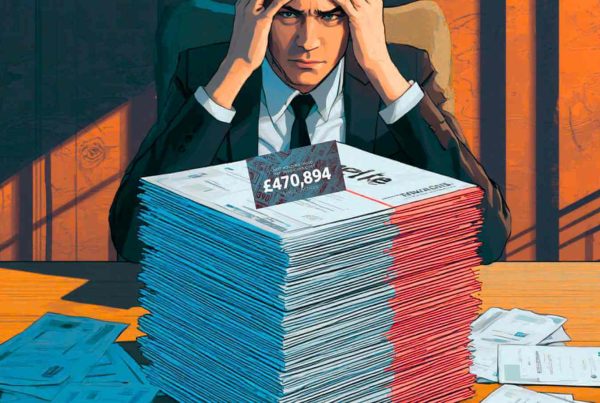
The Reliance On Tax Agent Defence Rule
The general rule is that reliance on a tax accountant or tax agent will not enable the taxpayer to overcome failures to comply with rules in terms of either filing returns or appealing against notices late or out of time.
If the taxpayer delegates matters to a tax accountant then a failure by that person will not relieve the taxpayer of the duty.
That of course does not mean in all circumstances the taxpayer will have no remedy. If a tax accountant has failed to comply with a taxpayer’s instructions and let us suppose that such failure has caused the taxpayer to suffer a loss then it is perfectly conceivable the taxpayer might have a claim to recover their losses through an action in negligence against the tax accountant.
However, an action in negligence against the tax accountant does not avoid the obligation to HMRC.
David Oakes v HMRC
In the case of David Oakes v HMRC [2022] UKFTT 413 (TC) the taxpayer instructed a tax agent who it seems may not have addressed matters. The Tax Tribunal rejected the taxpayer’s argument that he should be permitted to appeal out of time due to reliance on his tax agent whose employees had not followed proper office procedures.
The Katib Concept
The well known principle is that the failure of tax accountant or agent is a failure by the taxpayer. Indeed this rule is notable in that even spectacular incompetence by a tax agent goes not get the taxpayer off the hook. In the case of HMRC v M H Katib [2019] UKUT 189 the point was put bluntly:
It cannot be the case that a greater degree of adviser incompetence improves one’s chances of an appeal, either by enabling the client to distance himself from the activity or otherwise.
In the case of David Oakes the tax agent’s employees it seems did not follow proper procedure:
Regrettably for the appellant, we do not agree that this is a good reason. The evidence shows, as submitted by Ms Davies, that these employees simply failed to comply with office procedure. They might have done so in a significant way, and the consequences of that failure, on the appellant, might be dramatic. But it is not such rogue behaviour as to take the attribution of Howards’ failings to the appellant outside the Katib principle. Simply failing to comply with office procedure, in this case escalating the matters up to a director, rather than dealing with them oneself, is simply a breach of office protocol for which, we accept, an employer might be dismissed. But it is not such a frolic of their own as to enable us to say that there was such a fundamental breach of Howards’ duty to the appellant as to, effectively, mean that they were not properly acting as agent.
It is our view that in the same way that an agent’s failings are attributed to a taxpayer, the failings by that agent’s employees are attributed to that agent. Indeed in many cases where a large firm is appointed agent, and time limits are missed it is highly likely that the failure is due to a failure by an employee. It would not seem right to us that if, for example, KPMG were appointed agent with its huge numbers of employees, a taxpayer could say that the attribution principle does not apply because one of the employees had not complied with office procedure.. Unless the behaviour of the employee is so exceptionally egregious or vindictive that management could not be expected to police it, and it falls far outside the ambit of behaviour expected of an employee, failures by the employee should be attributed to the employer. And the employees’ failings in this case are not in that category. The employees might have been negligent or even irresponsible, but in our view that negligence or irresponsibility must be attributed to Howards. This might sound harsh, but in our view it is up to the appellant to take this up with Howards, rather than something which exonerates the appellant from the consequences of the behaviour of Howards’ former employees.
Green v HMRC
In the matter of Green v HMRC [2022] UKFTT 405 (TC) another taxpayer, Mrs Green, received £172,943.10 of income tax assessments for the tax years 2012-2013 to 2015-2016.
The appeal was issued late and the reasons provided for that were:
(1) HMRC did not correspond with Cobham Murphy as agents in relation to the assessments or debt recovery;
(2) Mrs Green relied on professional advisers; and
(3) no debt collection took place between March and September 2020 due to Covid so Cobham Murphy were unaware that HMRC were seeking to collect the debt until November 2020.
As to the question of reliance upon her accountant, the Tax Tribunal rejected this reason and said:
We are bound by the decision in Katib and, as a result, we are driven to find that the fact that Mrs Green was let down by Mr Russell and Cobham Murphy does not constitute a good reason for the failure to appeal.
Are you a UK company Director?
If you are a Director of an insolvent company or a bankruptcy, Oliver Elliot can help you. We Know Insolvency Inside Out.

Share This Page!
What Next?
Expert Advice Is Just A Click Away
If you have any questions in relation to Reliance On A Tax Agent Defence For Late Appeal To Tax Tribunal then contact us as soon as possible for advice. Oliver Elliot offers a fresh approach to insolvency and the liquidation of a company by offering specialist advice and services across a wide range of insolvency procedures.
Our expertise is at your fingertips.
Disclaimer: Reliance On A Tax Agent Defence For Late Appeal To Tax Tribunal
This page is not legal advice and should not be relied upon as such. This article is provided for information purposes only. You can contact us on the specific facts of your case to obtain relevant advice via a Free Initial Consultation.
Recent Posts / View All Posts