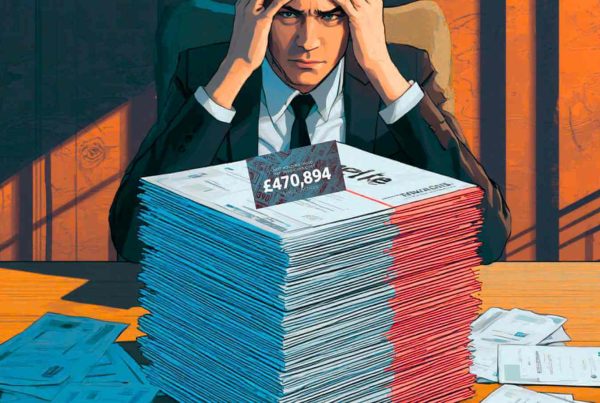
How To Avoid An HMRC Tax Investigation Overview
If you want to learn how to avoid an HMRC tax investigation then you have to consider what triggers HMRC to open a tax enquiry into someone’s finances.
HMRC is opening tax investigations with some speed and volume at the moment. For the quarter ended 31 December 2021 HMRC opened 207,000 new tax enquiries.
In this article, we will look at some of the key issues that can come up to trigger an investigation and showcase them by looking at a couple of real cases where a taxpayer did not avoid an HMRC tax investigation.

You will no doubt want to avoid being one of the increasing number of taxpayers subject to an HMRC tax enquiry.
It appears there is no shortage of people for HMRC to investigate. HMRC tax investigations generally arise without the need for sophisticated techniques such as surveillance that might perhaps be reserved for organised crime:
- HMRC appears to have plenty of people to investigate because the UK is the 5th largest economy behind China, the USA, Germany and Japan.
- HMRC will have notice of considerable volumes of people who are not compliant in submitting their tax returns by the due date. For example, an individual has to file their self-assessment tax return by 31 January of the year after the 5 April tax year. Yet as of 24 January 2022 it was reported that 4 million people had still to file their returns with only about a week left to do so.
- Tax investigations require resources and therefore HMRC has more work than it could ever realistically complete.
As a result, the matter of a failure to be compliant in filing tax returns causes HMRC to initiate tax investigations.
Key Facts On How To Avoid An HMRC Tax Investigation
- File tax returns on time.
- Review tax returns for inconsistencies.
- Investigate and correct inconsistencies.
- Retain documents that evidence the purpose of transactions when they were entered into.
HMRC Tax Compliance To Avoid HMRC Investigation
Perhaps one of the most common reasons for a tax enquiry to be opened is persistent failure to comply with HMRC tax filing requirements for tax returns.
Why? Well if a taxpayer does not file returns on time it is potentially bound to trigger the question of why and raise questions as to whether what was filed is accurate.
A persistent failure to file tax returns will almost certainly result in an HMRC tax investigation being started.
The problem is that even if the matter drifts (for in some cases years), eventually it will be addressed and there will be interest and penalty consequences for the taxpayer.
Inconsistencies In HMRC Tax Returns
If as a taxpayer you always file your returns on time then you can still be the subject of an HMRC tax investigation if your return or returns have identifiable inconsistencies.
Tax returns most commonly report to HMRC on a person’s income and assets. When a person (and similar points apply to companies) earns income and the person is not employed, they have to report their income to HMRC. The income will be assessed under the income tax rules.
In a similar but perhaps slightly less widespread way, certain types of assets when they are sold need to be reported in a person’s tax return to HMRC to account for any gains or losses to assess the capital gains tax position.
Perhaps the most obvious inconsistency that could arise to trigger an HMRC tax investigation is when someone lives a lifestyle not supported by the level of income and assets their tax returns suggest.
Living Beyond Your Means
Living beyond your reported means is a likely trigger for an HMRC tax investigation into someone’s tax affairs. How do we know this?
Well, because it is a feature of Tax Tribunal decisions when HMRC officers are called to answer questions to explain their concerns.
One of the ways in which HMRC investigates someone’s tax affairs is through an HMRC Tax Information Notice. This will enable HMRC to obtain information from the taxpayer to check their tax return(s).
In the recent case of Matthew Jenner v Revenue & Customs [2022] UKFTT 203 (TC) the Tax Tribunal observed the reasons for HMRC issuing an Information Notice to the taxpayer:
… the principle reason stated for issuing the information notices was to examine whether the whole of Mr Jenner’s liability to tax for each year has been correctly and completely self-assessed, with a core feature of this examination being Mr Jenner’s means position; that is, whether Mr Jenner’s costs of living could be funded by his available wealth and income.
So for example only, if you live in an impressive and expensive property a stone’s throw away from Her Majesty but your tax returns year on year say your earnings are so low that you do not pay any tax at all, you could wake up one morning to meet an HMRC brown envelope with notice that a tax enquiry had been opened into some of your recent historic tax returns.

Of course, you could have inherited the property or you may have sold other assets to acquire the property but even so, sumptuous properties can have considerable running costs. Throw in a Bentley and some buy-to-let properties on which you previously reported rental income to HMRC and a tax investigation may well get out of the starting blocks with some alacrity if your income reported to HMRC is below the personal allowance for income tax.
Missing Asset Sales
The story of the missing asset sale can often cause an HMRC tax investigation. But why?
Well, it is logical that people hold assets to derive economic benefit from them. For example, properties tend to generate rental income, shares in companies tend to derive dividend income and liquid investments such as cash in the bank tend to lead to interest income.
So if we pick a simple example of an individual with a buy-to-let property receiving rental income for a number of years what would cause that income to dry up? The property could be lived in by the owner instead of being rented out or perhaps it could have been sold. If someone is however already living in another property that is still recorded at HMRC as their correspondence address then there might be a decent chance the property was sold causing the rental income to dry up.
As a result, the sale of a buy-to-let property in such an instance will lead to a gain or a loss. Certainly, a gain on the sale of investment property must be reported to HMRC through your tax return.
HMRC collects information from a wide variety of sources and so may even learn about a property sale without looking at the person’s tax returns in the first instance. Nevertheless, rental income that stops being reported on to HMRC is a sound basis for an assumption that a property may have been sold. It does not necessarily mean it has been sold of course but it is certainly quite possible.
Example Of Rental Income and Property Inconsistency
This is what happened in the recent case of William Aggrey v Revenue & Customs [2022] UKFTT 200 (TC) which involved rental income and a property sale. Mr Aggrey acquired the property in December 1994 for £60,000. He had never lived in the property but his tax returns reported rental income to HMRC each year and in the build up to its sale the historic returns were as follows:
(1) Tax year 2010-11: rental income of £12,348 and an adjusted profit of £65 after expenses.
(2) Tax year 2011-12: rental income of £7,200 and a loss of £700 after expenses.
(3) Tax year 2012-13: rental income of £8,400 and a loss of £800 after expenses.
He then sold the property for £300,000 in February 2014 but the HMRC tax investigation revealed that his tax return for the year 2013-2014 did not record any rental income or capital gains tax on the sale.
Then in 2018, an HMRC tax enquiry sprouted. Four years later the matter came before the Tax Tribunal and he had to pay tax on rental income, capital gains tax on the sale of the property AND penalties as well.
Oliver Elliot Observation On How To Avoid An HMRC Tax Investigation
How to avoid an HMRC tax investigation requires the accurate calculation of tax, reported to HMRC in a prompt and compliant manner.
Tax is complicated and so you may wish to consider the best way to safeguard yourself to avoid an HMRC tax investigation is to appoint a diligent, competent and responsive tax professional to keep you on the straight and narrow with HMRC.
Are you a UK taxpayer?
If you are a taxpayer or a Director of a company, Oliver Elliot can help you. We Know Insolvency Inside Out.

Share This Page!
What Next?
Expert Advice Is Just A Click Away
If you have any questions in relation to How To Avoid An HMRC Tax Investigation then contact us as soon as possible for advice. Oliver Elliot offers a fresh approach to insolvency and the liquidation of a company by offering specialist advice and services across a wide range of insolvency procedures.
Our expertise is at your fingertips.
Disclaimer: How To Avoid An HMRC Tax Investigation
This page How To Avoid An HMRC Tax Investigation is not legal advice and should not be relied upon as such. This article How To Avoid An HMRC Tax Investigation is provided for information purposes only. You can contact us on the specific facts of your case to obtain relevant advice via a Free Initial Consultation.
Recent Posts / View All Posts