A dividend tax avoidance scheme appeal fails after being rejected by the Court of Appeal. This is the case of Clipperton & Anor v Commissioners for His Majesty’s Revenue and Customs [2024] EWCA Civ 180.
Like many tax avoidance schemes, this case involved the profits of a company available to be hoovered up. This was attempted as articulated by Lord Justice Nugee, without incurring an income tax charge.
Some tax avoidance schemes operate through loan arrangements such as those ostensibly assisted by employee benefit trusts and others such as this one was a share subscription scheme.
This dividend tax avoidance scheme it seems failed largely due to the decision in the matter of W T Ramsay Ltd v Inland Revenue Commissioners [1982] AC 300 (“Ramsay”). This was HMRC’s primary argument. Both the First and Upper Tribunals dismissed the matter on this basis.

WY’s Financial Position At The Time Of The Dividend Tax Avoidance Scheme
The company concerned Winn & Co. (Yorkshire) Ltd (“WY”) had distributable profits in early 2012 sufficient to enable a dividend of £200,000 to Sharon Clipperon and Steven Lloyd (“the Appellants”).
If one surfs over to Companies House you can see that WY had a profit and loss account with £672,605 and cash at bank of £643,455 as at 31 May 2012 based on the balance sheet approved by the Board of Directors on 15 February 2013. However, as it was early 2012 then it is possible the relevant accounts (those required for dividend purposes under Section 396 of the Companies Act 2006) for the £200,000 stated position would have been the accounts for the year ended 31 May 2011. These accounts also showed a positive profit and loss account of £698,706 and a comfortable cash balance position of £659,531.
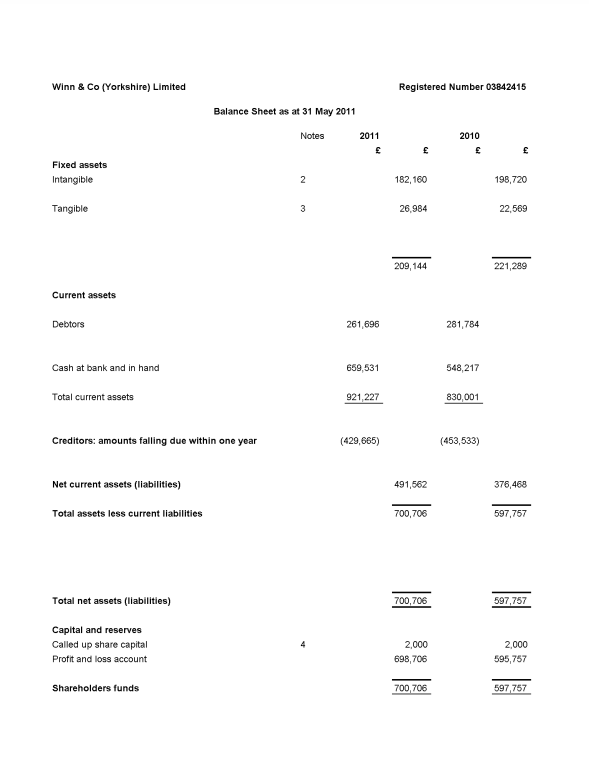
Ordinarily, dividends are subject to a tax charge in light of Section 383 of the Income Tax (Trading and Other Income) Act 2005 (“ITTOIA”).
Dividend Tax Avoidance Scheme Stripped To The Essentials
The tax avoidance scheme (“the Scheme”) was said by the Court of Appeal to be a scheme which culminated in a number of steps in which £200,000 went to the Scheme and the Appellants each received £98,465:
… stripped to its essentials Winn Yorkshire paid £200,000 into the scheme, of which, after a number of intervening steps, each Appellant ultimately received £98,465.
The results of the Scheme appeared in the Appellants’ tax return for 2011/12 but not as their income but income of WY. HMRC opened enquiries in March 2016 and considered the fruits of the Scheme were taxable in the hands of the Appellants. Thereafter the Tax Tribunal had two stabs at disposing of the matter. In both instances it threw out the appeals.
The Tribunal of first instance via Judge Morgan had this to say about the Scheme:
After setting out the facts Judge Morgan said in the FTT decision (at [16]):
“I find that the sole purpose of the relevant parties in implementing the arrangements described above was to enable Winn Yorkshire to provide its shareholders with the funds they received as a return on their investment in shares in Winn Yorkshire without attracting the income tax charge which usually applies to dividends or distributions made to shareholders. I did not understand the appellants to dispute that was the case.”
Summary Of The Dividend Tax Avoidance Scheme Steps
The steps in this dividend tax avoidance scheme involved a share subscription with cancellation of the premium to enable the subsidiary company to have distributable reserves
The Scheme is set out in paragraph 8 of the judgment in the Court of Appeal. In summary, it appears a core fact essentially involved having a subsidiary company and the shareholding arrangements would mean that WY would pay £200,001 for a share, of which £1 was par value and £200,000 a premium.
Then a short while later (2 days it appears) a resolution was passed in the subsidiary company (of which WY voted in favour as the sole voting member) to reduce the share capital of the subsidiary company by £200,000 by cancelling the share premium account, thereby affording the subsidiary company £200,000 of distributable reserves.
Two more days later the subsidiary declared a dividend of £200,000 of which the lion’s share (99%) would be held on trust for the Appellants.
How Did Ramsay Affect WY’s Scheme?
Ramsay is the famous case the House of Lords dished out on 12 March 1981 in which it highlighted that looking at a series of pre-planned steps in a tax avoidance scheme in isolation is a potential error.
A key feature of Ramsay was summarised by the Supreme Court subsequently in the case of Hurstwood Properties (A) Ltd & Ors v Rossendale Borough Council & Anor [2021] UKSC 16:
…the whole basis of the Ramsay principle is that it can be an error to view steps in an overall scheme in isolation. This is especially true where the step in question is one of a series of pre-planned steps in a tax avoidance scheme, as explained by Lords Briggs and Leggatt in Rossendale at [12]:
“Another aspect of the Ramsay approach is that, where a scheme aimed at avoiding tax involves a series of steps planned in advance, it is both permissible and necessary not just to consider the particular steps individually but to consider the scheme as a whole. “
Court Of Appeal’s Key Reason Dividend Tax Avoidance Scheme Appeal Failed
The dividend tax avoidance scheme appeal failed it seems because of its purpose to avoid tax

A regular feature in tax avoidance cases is not just preordained stepping but the matter of the exclusive purpose for such an approach which is to obtain a tax avoidance advantage.
A key reason the Court of Appeal did not allow this appeal appears highlighted in paragraph 30 of its decision:
Indeed the present case would seem to be a paradigm case for the application of the Ramsay principle. As explained by Lords Briggs and Leggatt in Rossendale at [15], the first stage of the requisite analysis is to “ascertain the class of facts … intended to be affected by the charge” (see paragraph 24 above). That requires a purposive construction of the statute. Subject always to the argument based on Khan, I see no reason to think that Parliament, which used widely expressed language (“any other distribution … in respect of shares in the company”) intended by these words to charge only a distribution by a company directly to its shareholders and not a distribution intended to reach, and which in fact reached, its shareholders by a more circuitous route via steps inserted into the overall transaction that “have no business purpose and have as their sole aim the avoidance of tax”: see Rossendale at [11]. As Lords Briggs and Leggatt there explain, such steps are often disregarded:
“This is not because of any principle that a transaction otherwise effective to achieve a tax advantage should be treated as ineffective to do so if it is undertaken for the purpose of tax avoidance. It is because it is not generally to be expected that Parliament intends to exempt from tax a transaction which has no purpose other than tax avoidance. As Judge Learned Hand said in Gilbert v Comr of Internal Revenue (1957) 248 F 2d 399, 411, in a celebrated passage cited (in part) by Lord Wilberforce in Ramsay [1982] AC 300, 326:
“If . . . the taxpayer enters into a transaction that does not appreciably affect his beneficial interest except to reduce his tax, the law will disregard it; for we cannot suppose that it was part of the purpose of the Act to provide an escape from the liabilities that it sought to impose.” “
Equally it cannot readily be supposed that when Parliament enacted ss. 383 to 385 ITTOIA and thereby sought to impose a charge to income tax on distributions by a company to its shareholders, it only intended such distributions to be taxable if paid directly to them, and that such distributions should escape liability for the tax if the participants took two or more steps to achieve this rather than one. Or as Judge Morgan put it in the FTT (at [121]):
“In my view, having regard to the natural meaning of the terms used in s 1000 CTA 2010 (as further explained in s 1113) and viewing those provisions in the overall context of Part 23 CTA 2010, the purpose of ss 383 to 385 as regards distributions is, in broad terms, to tax a shareholder on any value which a company delivers out of its assets into a shareholder’s hands by some non-prescribed means (whether directly or indirectly) as a return on his shareholding except where one of the specified exemptions apply.”
For a free no obligation chat about any of the matters detailed above, please do get in touch for help. An expert will call you back or if you prefer exchange emails.
We can explore your situation and consider the best way to help you and your business needs. You can call us 020 3925 3613 or fill in the form below and will get back to you quickly. We Know Insolvency Inside Out.


What Next?
Expert Advice Is Just A Click Away
If you have any questions in relation to Dividend Tax Avoidance Scheme Appeal Fails then contact us as soon as possible for advice. Oliver Elliot offers a fresh approach to insolvency and the liquidation of a company by offering specialist advice and services across a wide range of insolvency procedures.
Our expertise is at your fingertips.
Disclaimer: Dividend Tax Avoidance Scheme Appeal Fails
This page is not legal advice and is not to be relied upon as such. This article Dividend Tax Avoidance Scheme Appeal Fails is provided for information purposes only. You should take independent advice on the facts of your case. No liability is accepted for reliance upon this post.
Recent Posts / View All Posts