Business Asset Disposal Relief In A Members Voluntary Liquidation is a way of extracting your money in a tax efficient way that you have successfully built up in a Limited Company.

Business Asset Disposal Relief is the new description given to Entrepreneurs’ Relief.

You may have taken money out of your Limited Company by way of a dividend or salary but if you qualify for Entrepreneurs’ Relief, this will enable you to extract funds and be charged tax at a reduced rate as a Capital Gain, instead of it being treated as income. To do this you may find a Members Voluntary Liquidation a useful tool to enable you to claim this relief.

Business Asset Disposal Relief In A Members Voluntary Liquidation

What Is Business Asset Disposal Relief?

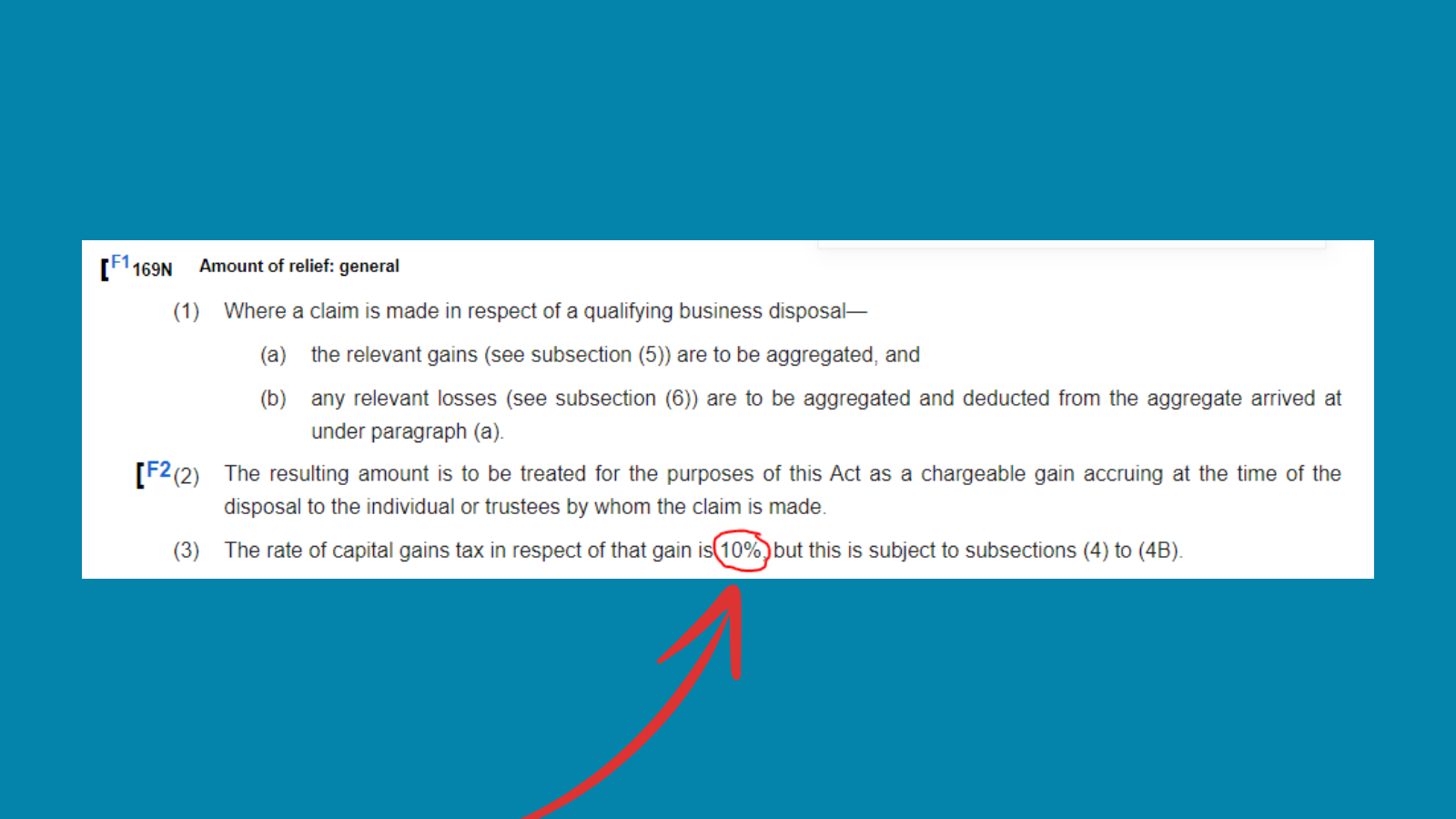
Entrepreneurs’ Relief is now called Business Asset Disposal Relief by virtue of Schedule 3 of the Finance Act 2020, which if you qualify, enables you to pay capital gains tax at the current rate of 10% by virtue of Section 169N(3) of the Taxation of Chargeable Gains Act 1992.

Changes to be applied due to the budget on 30 October 2024 mean that from April 2025 this rate will increase to 14% and then to 18% from April 2026.

10 percent capital gains tax on business asset disposal relief

The normal rate of capital gains tax is 24% if you are a higher rate taxpayer or 18% if you are a basic rate taxpayer.

If instead money was to be extracted from a limited company as dividends or salary, the tax rate suffered by the individual declared on their personal tax returns could be far higher. Dividends could be taxed at the rate of up to 39.35% and salary can even stretch to a rate of 45% if you meet the relevant threshold, so it is worth taking professional advice to see if you qualify for the appropriate potentially very valuable savings provided by Entrepreneurs’ Relief.

Business asset disposal relief is subject to a lifetime limit of £1 million by virtue of Schedule 3 of the Finance Act 2020.

It has sometimes been referred to as ‘retirement relief’ but you do not need to retire to claim it.

How To Qualify For Business Asset Disposal Relief In A Voluntary Liquidation

Business asset disposal relief is available if you have been trading for 2 years. If you are claiming the relief in respect of shares in a Limited Company, then the company must be a personal trading company with you either an employee or a director, having more than 5% of the ordinary shares and 5% voting rights. You must also be entitled to at least 5% of either:

  • profits that are available for distribution and assets on winding up the company
  • disposal proceeds if the company is sold

If the company has ceased trading you must dispose of your business assets within 3 years to qualify for relief.

You need to watch out for the anti-avoidance provisions set out in Section 396B of the Income Tax (Trading and Other Income) Act 2005. In particular, if you start the same or similar trade within 2 years of the date of the relevant distribution then it would cease to qualify for business asset disposal relief. This was designed to stamp out the practice of opening and closing companies with the same trade being carried out, whilst claiming the relief.

What Is A Members Voluntary Liquidation?

A Members Voluntary Liquidation is the orderly winding up of a solvent company. This option is not available to an insolvent company, in which case you might wish to consider a Creditors Voluntary Liquidation. If your company is insolvent then you will not be in a position to claim business asset disposal relief but you may be able to obtain other tax relief such as Terminal Loss Relief instead.

Upon the company being placed into Members Voluntary Liquidation a distribution can be made by the liquidator and the same is then subject to tax at the rate of 10% as a capital gain prior to April 2025, after which it will revert to 14%. It is to be declared on the personal tax return of the party claiming the business asset disposal relief.

When Might A Members Voluntary Liquidation Be Useful?

The circumstances in which a Members Voluntary Liquidation could be useful to you could be as follows:

  • You wish to close down your company and extract your hard earned cash.
  • You have no further need for the limited company and you have ceased trading.
  • The nature of your trading activities have fundamentally changed and all the assets in your limited company are no longer needed.
  • You wish to start a completely new trading venture in a new limited company and wish to extract your capital.
  • You are looking forward to a well earned retirement.

It is potentially useful if the level of assets exceeds £25,000 in light of Section 1030A of the Corporation Tax Act 2010 so that the capital gains tax advantages might be extracted instead of a distribution being assessed under the income tax rules. Under Section 829(2)(d) of the Companies Act 2006 a distribution to its members on winding up is not treated as a distribution for income tax and under Section 1030 of the Corporation Tax Act 2010 it is not a distribution for corporation tax. But under Section 122 of the Taxation of Chargeable Gains Act 1992 a distribution by a liquidator winding up a company can be treated as a capital distribution.

How To Claim Business Asset Disposal Relief

Business asset disposal relief is claimed on a personal tax return of the relevant employee or director who has made the capital gain. Alternatively, you can claim it on form HS275.

If you would like more information on this to see if we can assist you in such matters then please contact us for a Free Initial Consultation.

Want To Liquidate A Solvent Company?

£1,500 to liquidate a solvent company

Applies to the liquidation of an solvent company*

*Terms of engagement and VAT apply.

ready to apply
GET IN TOUCH FOR HELP

For a free no obligation chat about any of the matters detailed above, please do get in touch for help. An expert will call you back or if you prefer exchange emails.

We can explore your situation and consider the best way to help you and your business needs. You can call us 020 3925 3613 or fill in the form below and will get back to you quickly. We Know Insolvency Inside Out.

Author: Elliot Green
Last Updated: August 17, 2026

contact-us-and-get-called-back-red1.png

Name

100% Confidential Advice
We Know Insolvency Inside Out

Share This Page!

What Next?

Expert Advice Is Just A Click Away

If you have any questions in relation to Business Asset Disposal Relief In A Members Voluntary Liquidation then contact us as soon as possible for advice. Oliver Elliot offers a fresh approach to insolvency and the liquidation of a company by offering specialist advice and services across a wide range of insolvency procedures.

Our expertise is at your fingertips.

Name

By submitting this form you agree with the storage and handling of your data by Oliver Elliot. For more details, please read our Privacy Policy.

Opt in

Disclaimer: Business Asset Disposal Relief In A Members Voluntary Liquidation

This page is not legal advice and is not to be relied upon as such. This article Business Asset Disposal Relief In A Members Voluntary Liquidation is provided for information purposes only. You should take independent advice on the facts of your case. No liability is accepted for reliance upon this post.

Recent Posts / View All Posts

Write Off The Loan, Write In The Taxman

Write Off The Loan, Write In The Taxman 

| Director Transactions, HMRC, Liquidation | No Comments
There are occasions when tax law achieves something seemingly rather remarkable: it manages to be perfectly logical and yet may arguably produce some inconsistency at the same time. The recent…
Insolvency Practitioner Fees: When Nobody Can Mark the Homework The Judge Will Insolvency Practitioner Fees When Nobody Can Mark the Homework The Judge Will

Insolvency Practitioner Fees: When Nobody Can Mark the Homework The Judge Will

| Liquidation | No Comments
The recent Float Capital Ltd, In the Matter Of EWHC 1891 (Ch) judgment is not simply another decision about insolvency practitioners' remuneration. It is a reminder that where the normal commercial…
Liquidator’s Assignment Of Claims Challenged On The Basis Of Validity Of Appointment

Liquidator’s Assignment Challenged On The Basis Of Validity Of Appointment

| Liquidation | No Comments
The case of Henderson & Jones Ltd v Chambers & Anor (Re Priors Group Ltd) EWHC 1152 (Ch) involved dismissal of a summary judgment application issued by the applicant who…
Liquidator’s Claim Defeated By Disclosure Difficulty

Liquidator’s Claim Defeated By Disclosure Difficulty

| Liquidation | No Comments
Disclosure is an important part of litigation. At its core, it serves to function as a means of furthering attempts at a fair trial. The consequences of inadequate disclosure can…