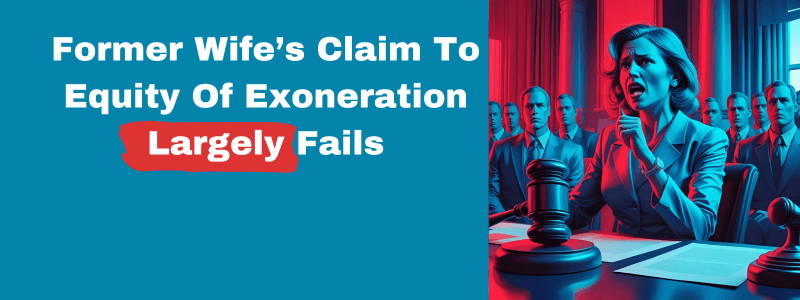
Former wife’s claim to equity of exoneration largely fails against Trustees in Bankruptcy, comes from the case of Armstrong & Anor v Harrow [2025] EWHC 1790 (Ch).
The property known as the Old Manse, which was jointly owned by the bankrupt and the former wife, was sold on 31 July 2020, with the sale proceeds hoovered up by various charges. The numbers involved were not trivial.
The first slice of the pie went to MSP Capital Ltd in the sum of £1,050,675. The next largest serving was £106,560 for AIF 1 Ltd, then Access Commercial Investments Plc was helped to £55,976.14, and finally, in relative terms, crumbs went to Merchant Money Ltd in the sum £17,984.65.
That left £152,447 to be paid to the former wife.
The husband was made bankrupt on 5 November 2020. Almost four years later, an application was brought to recover half the next proceeds of sale paid to the former wife. £76,223.50 from the sale of Old Manse and half of the amount paid to discharge the loan of Access Commercial, which was a loan secured on another property of the former wife.
What Is Equity Of Exoneration?
Equity of exoneration is a legal doctrine that applies when a property is jointly owned and charged to secure the debts of one party. If the debts were for the benefit of one party, then it may be that the other joint owner can be entitled to have the indebtedness discharged out of the other party’s interest in the property:
The principal case on the equity of exoneration in recent times is Armstrong v Onyearu [2018] Ch 137.
…
On a further appeal to the Court of Appeal, David Richards LJ, as he then was, described the operation of the doctrine as follows:
“1 Where property jointly owned by A and B is charged to secure the debts of B only, A is or may be entitled to a charge over B’s share of the property to the extent that B’s debts are paid out of A’s share. This is known as the equity of exoneration. Although this label, and its origins in the protection given by equity to married women’s property rights before the Married Women’s Property Act 1882 (45 & 46 Vict c 75), lends an obscure, even archaic, air, it is best understood as part of the relief more generally given to sureties against the principal debtor. It is as much a feature of contemporary law as it was of equity in the 18th and 19th centuries.
2 The most common example of jointly-owned property is a house or flat owned by a cohabiting couple, married or unmarried. For this reason, the cases in which the courts usually encounter the equity of exoneration are those in which, first, an unmarried couple separate and their interests in the property must be determined; second, a cohabitee, whether married or unmarried, becomes bankrupt and the trustee in bankruptcy seeks to realise the bankrupt’s share of the property; and, third, a judgment creditor of one cohabitee, married or unmarried, seeks to enforce the judgment against the property. But the equity is not confined to cohabiting couples and may arise in the case of any joint owners of property: see, for example, Gee v Liddell [1913] 2 Ch 62 and In re A Debtor (No 24 of 1971), Ex p Marley v Trustee of the Property of the Debtor [1976] 1 WLR 952.”
…
David Richards LJ noted that the court was not asking, literally, “Who got the money?” but was focussing on whether the wives obtained a benefit from the loan. In the event, the benefit identified was too remote, incapable of calculation and insufficient to displace the evidential presumption as to the intentions of the parties. He concluded that none of the cases cited, either those English cases since In re Pittortou or the Commonwealth authorities, provided support for the proposition that such an indirect benefit, or the possibility of such benefit, would prevent the equity arising.
Why The Trustees Said No Exoneration Applied
The Trustees in Bankruptcies dug their trench on the Western Front and said that equity of exoneration did not apply because the loans were not made to the bankrupt but to a company, Callian Management Services Limited (“C Ltd”) of which the bankrupt and former wife were shareholders and directors. It was accepted by the Trustees that the loans largely went to discharge former lending to the bankrupt’s company Watercare International Limited (“W Ltd”).
The former wife’s trench, on the other hand, was positioned to say that her former husband was the effective beneficiary of the loans secured over Old Manse. She contended that she received no benefit from some of the loans and that she paid substantial sums to the bankrupt.
The Trustee’s investigations of the bank statements of the bankrupt seemed to show a sumptuous £314,000 going in the direction of the former wife. However, the former wife rejected that proposition, saying that there were various loans from her or her company for the benefit of W Ltd, which needed to be offset, culminating in a proof of debt that she lodged in the bankruptcy in the eye-watering sum £1.4 million.
Judgment Highlights

Insolvency and Companies Court Judge Mullen said that the former wife’s directorship and shareholding in C Ltd was not necessarily fatal to her exoneration claim. However, in analysing the former wife’s involvement in C Ltd was considered and the court said:
Mrs Harrow accepted in her oral evidence that she had similarly signed personal guarantees for Callian’s indebtedness. These are not in evidence. The giving of a personal guarantee of the debt of a company is a form of surety and I reject Mr Brown’s submission that it, of itself, makes Mrs Harrow a principal debtor, rather than a surety. Nonetheless, the giving of such personal guarantees is suggestive of an active participation in the affairs of Callian and the assumption of liability as director of the company, rather than a surety at one remove from the affairs of the principal debtor company.
What is clear is that Mrs Harrow was responsible, with her husband, for the taking of the loans by Callian. She is an experienced businesswoman, with a number of companies of her own. She agreed to the loans and signed documentation to give effect to them. They were not made without her knowledge or consent.
…
I am not persuaded that Mrs Harrow’s role in Callian was illusory or insignificant. She was at all material times a director and a shareholder. She was an active director, executing documentation connected with obtaining the loans that were ultimately secured on The Old Manse and Bell Street and offering personal guarantees. She used its accounts, albeit for her own business purposes. She agreed to the loans and to the use that would be made of them. It is impossible to form the conclusion that, despite the position recorded at Companies House, she had no real role in the direction of the company or, as shareholder, a financial interest in it. That financial interest is no less real because, as I accept, Mrs Harrow had not, at the point the loans were made, received a salary or dividend from Callian.
…
It will be apparent from the above that I am not satisfied that Mrs Harrow, despite being a director and shareholder of Callian, was not involved in that company in any real sense. On the contrary, not only was she a director but she acted as such in the execution of documents, and she used the company’s account for her own purposes. Mrs Harrow accepted that she understood the obligations that appointment as a director entailed, and indeed she was a director of other companies, independently of Mr Russell, at the time. As a shareholder she had a direct financial interest in the company. To ask, simply, “Who got the money?” would ignore the reality that the loan was made to a company of which both Mr Russell and Mrs Harrow were the owners and the decision makers and I am not satisfied on the balance of probabilities that Mrs Harrow was unable make decisions freely or that she was no more than a cypher for her then husband. It follows that Mr Russell and Mrs Harrow are to be regarded as joint principal debtors for the purposes of determining the existence of an equity of exoneration in relation to the loans to Callian. It was accepted by Mrs Harrow that there was no agreement between Mr Russell and her as to how the liability should be apportioned between them and there is no basis to imply one. There is thus no basis to depart from the default position of equal liability.
…
That is subject to one exception in relation to the secured loan from Merchant Money in September 2019. This was pursuant to an agreement between Merchant Money and Watercare. Here I have to consider whether the presumption arising from the loan being made to Mr Russell’s company has been displaced. It has not. While I am not satisfied that Mrs Harrow had no real interest in the jointly owned company, Callian, so as to displace the default position of equal apportionment of liability, by the same token the trustees have not satisfied me that Mrs Harrow derived any tangible benefit from this small loan made to Watercare, a company in which it is accepted she had no interest. Any indirect benefit that she might have obtained from it is intangible and impossible to quantify. It follows that Mrs Harrow is entitled to an equity of exoneration in respect of the £17,984.65 paid to Merchant Money from the proceeds of sale.

For a free no obligation chat about any of the matters detailed above, please do get in touch for help. An expert will call you back or if you prefer exchange emails.
We can explore your situation and consider the best way to help you and your business needs. You can call us 020 3925 3613 or fill in the form below and will get back to you quickly. We Know Insolvency Inside Out.


What Next?
Expert Advice Is Just A Click Away
If you have any questions, then contact us as soon as possible for advice. Oliver Elliot knows insolvency inside out.
Our expertise is at your fingertips.
Disclaimer
This page is not legal advice and is not to be relied upon as such. This article is provided for information purposes only. You should take independent advice on the facts of your case. No liability is accepted for reliance upon this post.
Recent Posts / View All Posts